



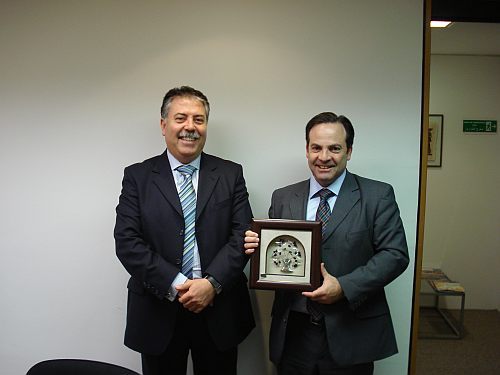
São Paulo – The ambassador of Tunisia in Brasília, Sabri Bachtobji, is promoting his first official visit to São Paulo this week, with an agenda full of engagements turned to promoting trade, investment tourism and cultural exchange. “I believe much in economic diplomacy,” said the diplomat to ANBA on Wednesday (26), after a meeting with Arab Brazilian Chamber of Commerce president Marcelo Sallum, and Foreign Trade vice president Rubens Hannun, at the organisation’s offices, in São Paulo.
The diplomat has been in Brazil for two months and sees many opportunities to increase relations between both countries. “We already have great political relations and a tradition of friendship,” he pointed out. “I feel that there is much natural empathy between both peoples,” he added.
On Wednesday, Bachtobji also met with representatives of the da Brazilian Association of Producers, Importers and Traders of Olive Oil (Oliva), one of the main products exported by Tunisia. “We are the second main producer, after the European Union,” he pointed out.
He believes that there is space for expansion of sales to Brazil. “Exports are small as against the Tunisian capacity. There is great potential to put this high-quality olive oil on the table of Brazilian consumers,” he pointed out.
In São Paulo, the diplomat will also accompany a Middle East and Africa Exporter Association (Maex) delegation, which represents Tunisian companies that produce food like olive oil, preserves and dates. The executives are in the city to visit the Sial and Biofach, fairs in the sector that are taking place this week, and on Friday (28) they will promote sampling of dishes made with Tunisian ingredients for the Brazilian audience. Bachtobji stated that the Arab Brazilian Chamber helped organize a “rich agenda” with importers and exporters.
The ambassador said that companies from his country have already confirmed presence at the next edition of the São Paulo State Supermarket Association (Apas) fair, in 2014, and pointed out that in Tunisia there are over 80 international business fairs each year: the events could include Brazilian businessmen. “One of the missions of the embassy is to encourage this participation and also to invite Brazilian businessmen to events in Tunisia,” he said.
To him, business fairs are “great occasions” for economic players in both countries to meet and “establish projects for international partnerships”, also in the area of investment. Last week, the Arab Brazilian Chamber signed an agreement for cooperation with the Fipa, the Tunisian investment promotion agency, with the objective of promoting activities in the area. One of the events under study is a seminar on the theme during the Apas 2014. “It is a new instrument to develop cooperation between both countries,” said Bachtobji, regarding the agreement.
On Thursday (27), the diplomat should meet representatives of the Federation of Industries of the State of São Paulo (Fiesp), the Brazilian Beef Industry and Exporters Association (Abiec) and the Brazilian Association of Tourism Operators (Braztoa).
“Our [bilateral] trade includes many primary products, and we must diversify it and include products with higher added value,” he pointed out. In the same way, he believes it is possible to expand tourism. Today, some 3,000 Brazilians visit Tunisia each year, according to the diplomat. “We invite Brazilians to visit a country with millenary history. We have an affluence of Mediterranean civilisations,” he stressed.
In the cultural area, Bachtobji met, at the Arab Brazilian Chamber, with the organisations International Relations vice president and founder of the Arabic course at the University of São Paulo (USP), Helmi Nasr, and with the director of the Library and Centre of South American and Arab Research (Bibliaspa), Paulo Farah. They spoke about the translation into Portuguese of Tunisian works of reference and also about the translation of Brazilian books into Arabic, as well as about the participation of Tunisian musicians in festivals in Brazil and vice-versa. “Cultural and economic relations walk hand in hand,” pointed out the ambassador.
*Translated by Mark Ament

