



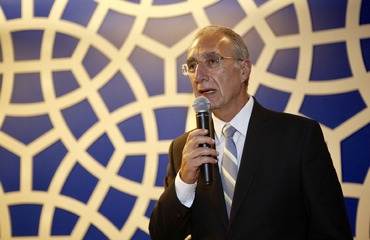
São Paulo – The Management Council of the Arab Brazilian Chamber of Commerce elected Tuesday (31) night its board of directors for the 2017/2018 biennial. The new president is business owner Rubens Hannun, who held the post of vice president of Foreign Trade in the last administration. He replaces Marcelo Sallum, who led the organization for two consecutive terms.
In an interview with ANBA, Hannun talked about his expectations for the next few months. “We will face many challenges. The world is upside down, the imponderable has taken center stage, thus the challenges are immense,” he said. “But the path will be milder, smoother, due to the state in which we are receiving the Arab Chamber. All the boards of directors had been building and the last one left the organization well-structured,” he added.
He pointed out that the new management taking over has, on one side, thoughfulness and experience and, on the other, boldness, innovation and invention. “It’s a sum that we will transform into opportunities for sure,” he added.
Hannun will have on the board of directors with him the vice presidents Adel Auada (Management), Ruy Carlos Cury (Foreign Trade), Osmar Chohfi (Foreign Relations), Riad Younes (Marketing) and the director of Treasury, Nahid Chicani. Michel Alaby remains as the organization’s CEO.
The president believes that the unsettled state of the world, in Arab countries and Brazil itself, will require new solutions and services. Trade promotion between Brazil and the Arabs is the Chamber’s main goal, but Hannun says that the work in other areas of cooperation can strengthen economic relations. As examples, he mentions culture, tourism, education, medicine and sports. “All of this ends up impacting trade,” he says.
Along this line, the executive highlighted the importance of “recognizing our social responsibility” both in Brazil and the Arab countries. “We need to continue to work on the image of Arabs in Brazil and of Brazilians in the Arab world,” he said.
This also means welcoming and helping integrate the immigrants from the Middle East and North Africa currently arriving in the country, just like the parents and grandparents of many Brazilians of Arab descent were welcomed in the past. “It’s part of our duty, the Chamber emerged from this,” said Hannun. “Our families arrived just like this, as immigrants, and Brazil welcomed them with open arms,” he remarked.
He mentioned that his father, Jorge Hannun, born in Syria, was one of these immigrants, and that his mother, Laurinda Christofi Hannun, was the daughter of Syrian parents that settled in Brazil. “It’s now up to us to welcome the new generations,” he added.
The president supported the idea of aligning trade interests with the fulfillment of other demands. In the Arab world. For instance, there’s great concern with food security. Brazil, as a major food producer and exporter, can not only supply the products but also cooperate broadly with the region in this area of concern.
Rubens Hannun, 65 years old, majored in Business Management and took his postgraduatE studies in Research Methodology at the Institute of Management of the University of São Paulo (USP). He was a professor at Business School São Paulo and at the School of Higher Education in Advertising and Marketing (ESPM) and the president of Brazilian Association of Market Research Professionals (ASBMP). He teaches about Arab and Muslim markets in a course offered by the Federation of Muslim Associations in Brazil (Fambras) in partnership with Brazil’s Ministry of Foreign Affairs (Itamaraty).
He is the president of H2R Advanced Research, a consulting, research and marketing company founded in 1988 whose clients include Via Varejo (holding company of Casas Bahia and Ponto Frio), GS1 Brasil (Brazilian Automation Association), an organization that promotes and implements the use of bar codes in the country, Invepar, a transportation infrastructure concession company, the Brazilian Pay TV/Telecom Association (ABTA), Lamsa, Burson-Marsteller Comunicação and the car rental chain Movida.
Hannun has been with the Arab Chamber for 22 years. He already held the posts of director, vice president of marketing and twice vice president of Foreign Trade. He thanked former presidents who opened the doors of the organization and trusted his work in this period: Orlando Sarhan, Paulo Atallah, Antonio Sarkis Júnior, Salim Schahin and Marcelo Sallum. “The Chamber is the home of all of us,” he said, adding that members of the council, directors, former directors and the Council of Arab Ambassadors in Brazil are always welcome to give suggestions on the organization’s work.
Partnership
Attending the event, the dean of the Council of Arab Ambassadors in Brazil and Palestine’s ambassador, Ibrahim Alzeben, said, in line with Hannun, that the world is going through troubled times and that Brazil is facing difficulties. “This doubles the president’s work,” he said. “But you can count on the Council of Ambassadors. I can’t imagine the continuity of our work without you. If we achieve success is because of your support and professional work,” he remarked. “You are our partners, a bridge that unites the Arab world and Brazil,” he added.
Now-former president Marcelo Sallum looked back on his four-year term leading the Arab Chamber. “We have been to virtually all [of the organization’s] represented countries,” he said.
As highpoints of his administration, Sallum cited the talks for the resumption of beef exports from Brazil to Saudi Arabia after a three-year ban. “We were actively involved in the process of lifting the embargo,” he asserted, adding that the annual beef sales potential to that particular country is USD 200 million.
He also highlighted the Chamber’s participation in events such as the 4th Summit of South America-Arab Countries (Aspa), business forums and matchmaking sessions, trade shows in Brazil and other countries, trade missions, fundraising campaigns for Palestinian refugees, visits by Arab businesspersons and authorities to Brazil, agreements entered into with other organizations, and numerous other actions, in many of which it acted as the main organizer.
Regarding his successor, Sallum underscored his “utter competence.” “He knows the organization like no one else, and he has an amazing team at his side,” he stated.
Hosted by Management Council chairman Walid Yazigi, the ceremony took place in the new Arab Chamber headquarters’ auditorium, in the Santa Catarina building on Avenida Paulista, São Paulo, across the street from the old facility. The premises are yet to open. “We have a new home, so now we must think about what lies ahead for the Chamber,” concluded Hannun.
*Translated by Sérgio Kakitani and Gabriel Pomerancblum

