



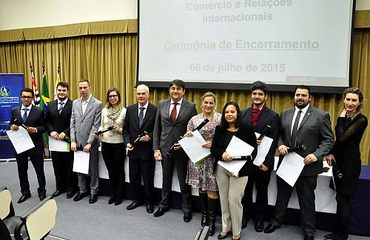
São Paulo –Higher education institution Faculdades Integradas Rio Branco and the Arab Brazilian Chamber of Commerce hosted this Monday (6th) the graduation ceremony of the first class in the Executive MBA in Management and Leadership in Trade and International Relations, a post-graduate course created in tandem by the two organizations. A total of 14 Arab Chamber directors and staff who completed the 18-month program were awarded their diplomas.
During the ceremony, Arab Chamber president Marcelo Sallum stressed that the purpose of the custom-tailored course was to enable the collaborators’ academic and professional development, enhancing their knowledge of the organization’s scope of action, and fostering interaction between its leaderships.
“These goals have been fully reached,” said Sallum. To him, being able to contribute to the “continuous knowledge acquisition process” of his collaborators is a “source of pride” to the Arab Chamber.
The Chamber’s Treasury director Nahid Chicani asserted that the MBA program was customized “with the Arab Chamber’s full cooperation in terms of curricula and professors.” Chicani presides over the Rotary Foundation in São Paulo , which maintains Faculdades Rio Branco. “Today, you (the post-graduates) are better prepared to meet professional challenges and to [support] the growth of the Arab Chamber,” he said.
The class’ sponsor, Arab Chamber CEO Michel Alaby noted that Brazil is going through a moment of economic and political change, and that there are new challenges to address in order for a corporation to continue offering the best products and services. “And the facing of this challenge requires skills,” he said.
Faculdades Rio Branco CEO Edman Altheman underscored the groundbreaking character of the program, which, apart from being designed jointly by the two organizations, combined onsite classes and distance learning. “Everyone talks about doing it (combining both systems), but we actually did it,” he said.
Altheman added that the “specialist” title conferred upon the graduates even accredits them to teach at higher education institutions, if they so wish.
The Arab Chamber Human Resources director Márcio Oliveira, one of the project’s creators as well as a student, said the curriculum was devised to combine technical training in administration with specific contents about Arab and Islamic markets. “It was virtually an experimental course. The faculty took a very open, free approach toward content development,” he said. Oliveira remarked that the curriculum and the topic of the final paper were built around the Arab Chamber’s line of business, namely trade with Arab countries.
Faculdades Rio Branco academic director Alexandre Uehara stated that because of the initiative’s groundbreaking character, this class of graduates is going down on the history that was never done before. "You are the pioneers in this,” he said. Professor William Nogueira added that the course was a one-of-a-kind project, the outcome of labor from “many hands.”
Leaders of both organizations are discussing having a second class and offering exchange programs with foreign universities, since Faculdades Rio Branco sustains agreements with several non-Brazilian institutions.
“This [course] will certainly be the first of many to come,” said valedictorian Juliana Burza, from the Arab Chamber’s Marketing Department.
*Translated by Gabriel Pomerancblum

