



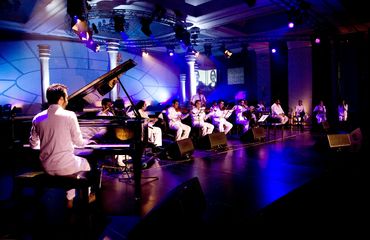
São Paulo – Festival Mimo, Brazil’s largest free instrumental music event, will feature Arab musicians for the first time in this year’s edition, due from August 23rd to September 8th. The group Rum Tareq Al Nasser, from Jordan, and the trumpet player Ibrahim Maalouf, from Lebanon, will perform and host workshops in the cities of Paraty (Rio de Janeiro), Ouro Preto (Minas Gerais) and Olinda (Pernambuco), in August and September.
The Jordanian group is led by keyboardist Tareq Al Nasser and combines Arab music with Latin rhythms and elements of jazz, blues and reggae. The band uses instruments such as the derbak, an Arab drum, and traditional Western ones such as piano, violin, electric bass and saxophone.
“It is truly innovative,” says festival director Lu Araújo regarding the combination of rhythms and instruments that Rum does. “Other artists do it, but the way Tareq has put it together, with an orchestra, is brand new,” she explains. To her, “the highlight of this year” is the Jordanian band’s participation.
Rum will play in Paraty on August 24th and in Ouro Preto on August 31st. “Tareq is really prominent in Jordan. He is a renovator of Arab music,” says Araújo.
Of the 20 musicians who comprise the band, ten are coming to Brazil, and the group will be complemented by eight Brazilian musicians. “The strings and winds will be Brazilian,” says the director.
In addition to the concerts, the bandleader will give two workshops about Tradition and Modernity in Arab Music, one in Paraty and another in Ouro Preto. “He will convey a bit of his experience with Arab music and how he rebuilds it. He will show how he approaches these parallels, the influences that Arab music is getting from other countries in the world,” she explains.
Jazz, Arab style
The Lebanese-born, French-based trumpet player Ibrahim Maalouf will be another attraction at Mimo. He will perform on August 29th in Ouro Preto and on September 5th in Olinda. “Ibrahim is a very established musician, he is one of the leading names of European jazz and he is carving his own space in the United States, says Araújo.
Maalouf’s contemporary jazz style fuses classic and traditional Arab music and rock, electro, pop, soul, French chansons and world music.
Maalouf will also teach the class Trumpet: from East to West, in Olinda. “He will show how the trumpet is placed in the East, and how it heads West in the music he is making now,” explains the director of Mimo. The musician will also show how the quarter-tone trumpet, an instment Maalouf’s father created.
The Festival
Created in 2004 as the Olinda International Music Festival, Mimo will have its tenth edition this year, covering three Brazilian cities. In 2013, in addition to Brazilians and Arabs, the festival will also feature musicians from Belgium, Germany, Portugal, France, Italy, Mozambique, United States and Cuba.
In addition to the concerns, all participants will also give workshops and classes targeting professional musicians and students. “They will pass on their experiences as musicians, their study methods,” says Araújo. Registration for the workshops and classes this year will remain open until August 4th.
The cities selected to host the festival, according to the director, are usually historical municipalities such as Paraty and Ouro Preto, or ones that have important historical sites, such as João Pessoa (Paraíba) and Recife (Pernambuco), which have hosted the event in the past. The concert venues are always a part of the cities’ historical heritage.
Mimo also includes a section dedicated to cinema, featuring films whose main topic is music. This year, 26 titles will be shown. “We will show films that have not premiered in commercial theatres,” says Araújo.
Service
Festival Mimo
August 23 to September 8
In Paraty (Rio de Janeiro), Ouro Preto (Minas Gerais) and Olinda (Pernambuco)
The Festival’s concert schedule is available at http://mimo.art.br/programacao
For additional information on Tareq Al Nasser’s workshop go to http://mimo.art.br/etapa-educativa/workshops
For additional information on Ibrahim Maalouf’s class go to http://mimo.art.br/etapa-educativa/master-classes
All of the Festival’s activities are of charge.
*Translated by Gabriel Pomerancblum

