



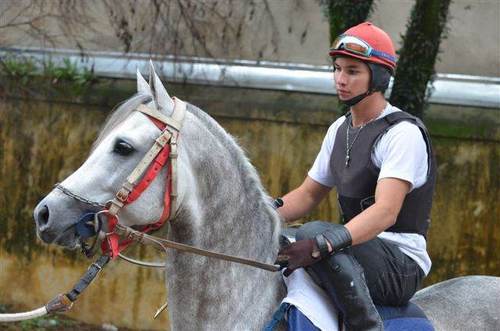
São Paulo – After nine years away from the races, Arabian horses will start competing in Brazil again. The first events will take place in September at São Paulo’s Jockey Club and should involve up to 40 animals, all bred in Brazil. A grand prize should take place in November.
According to the race director at the Brazilian Association of Arabian Horse Breeders (ABCCA, in the Portuguese acronym), Paulo Jamil Saliba, races with Arabian horse occurred in Brazil in 1996, 2002 and 2004, in the cities of Curitiba, Porto Alegre and São Paulo. The races were suspended, however, because the horse owners prioritized Arabian horse breeding for exhibitions rather than competition, due to strong demand from the United States market.
“(The Americans) were great buyers of horses for both Halter contests, in which the animals that meet the race’s standards the most win, and for Performance. The demand for export race horses was too low, so most breeders were not interested,” says Saliba.
“Now, there is a global resurgence of Arabian horse races, with high bets and sponsorship from the sheikhs. Right now, they are racing in 17 countries,” said Saliba. There are Arabian horse races in the United States, France, Australia, the United Arab Emirates and Qatar, among other countries. In 2012, 472 purebred Arabians raced worldwide, earning over 7 million euros worth of prizes. “It is a booming market, and Brazil has all it takes to gradually earn its place in the global scenario,” says Saliba.
The Arabian purebred is regarded as the world’s oldest, alongside Turkmenistan’s Akhal Teke race. The earliest records of the race date back to the 16th century BC. In the 17th and 18th, animals of the race were used in the improvement of British horses. According to Saliba, the main features of the animal are being “hot blooded,” brave, attentive, fast and resistant. “They can be ridden fast for several hours, and have great recovery capacity with short periods of rest,” explains Saliba, who is also an advisor to the Arab Brazilian Chamber of Commerce , and a breeder of the race.
São Paulo Jockey Club in a new phase
Saliba believes Arab horse races may benefit from the new phase of the São Paulo Jockey Club, which is renegotiating debts and improving its betting system. Total race revenues should go from the current R$ 100 million per year to R$ 400 million. According to Saliba, the races will be broadcast by Band Sports. “We were lucky that the Jockey Club is at a good moment, there are forecasts of increased visualization and sales. This is a new market and we may see good results,” he says. The races will be run on grass or sand, in 1,200- and 2,000-metre tracks.
Saliba believes that the return of the Arabian breed to racing may cause an increase in Arabian horse auctions in Brazil, and originate a market for the colt, at auctions and for sports such as Enduro (long distance racing), Barrel (around barrels in a circuit), Team Penning (in which the horse is used for splitting cattle up into herds) and Steeplechase (in which the animal and the jockey must pass through obstacles).
Horse auction
On Saturday (6th), the state of Mato Grosso do Sul will host the International Enduro Festival and the Haras Engenho Auction, including Arabian horses. The enduro race will start at 6:00 am and the auction, at 2:00 am. Twenty animals will be auctioned, including 17 females and three males, two eggs and one embryo. The Stud Farm is in Maracaju, 134 kilometres away from the Mato Grosso do Sul state capital Campo Grande.
*Translated by Gabriel Pomerancblum
