



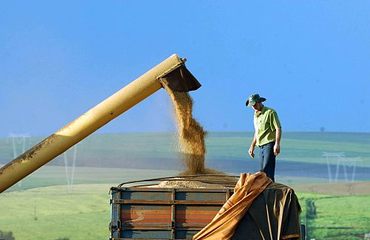
Brasília – The 2015/2016 crop of grains in Brazil should reach 210.5 million tons, a record production. It’s 1.4% more in volume than the previous crop, an increase of 2.8 million tons. This estimate is part of the 2015/2016 crop survey released this Tuesday (12th) by the National Supply Company (Conab). In the previous survey, the forecast was slightly higher: 211 million tons.
“It’s a record-breaking crop and it brings up important issues such as the recovery of [the state of] Goiás, which, last year, had serious drought problems and now is recovering all its productivity. Some regions that had losses last year are recovering so the global data looks very positive”, says the secretary of agricultural policy of the Ministry of Agriculture, André Nassar.
“In this first half, we are maintaining the expectation of the largest crop of grains in the country’s history. Despite climate effects, this is being fine-tuned in with public policies and technology”, says Conab’s director of agricultural policy and information, João Marcelo Intini.
The highlight of the survey was soy, with a 6.1% growth estimate, going from 96.2 to 102.1 million tons. In turn, maize (first crop) declined 7.7%, going from 30.1 to 27.8 million tons. The survey says this occurs because producers are opting to plant soy in maize’s areas, going back to maize (second crop) only after this first soy harvest.
The estimate for planted area in Brazil stands at 58.5 million hectares, an increase of 0.9% over the previous crop. The survey says that this result is due to 3.5% growth in planted area for soy. The other crops had a decline in planted area, with castor bean the only exception, registering a significant increase of 56.4%.
On the effects of the climate event known as El Niño, which impacts agricultural production, Intini says that information from meteorology institutes indicate that it will lose strength starting March. “Since it was an atypical El Niño, the strongest ever recorded, its effects also aren’t very precise and, thus, we are monitoring it.”
In Rio de Janeiro, the Brazilian Institute of Geography and Statistics (IBGE) reported that the Brazilian crop of cereals, pulses and oilseeds ended 2015 with a production of 209.5 million tons, overcoming 2014’s production in 7.7%. For 2016, the third forecast done by the institute indicates a production of 210.7 million tons, exceeding in 0.5% 2015’s numbers. IBGE does its survey using a calendar year, while Conab uses the crop year.
*Translated by Sérgio Kakitani

