



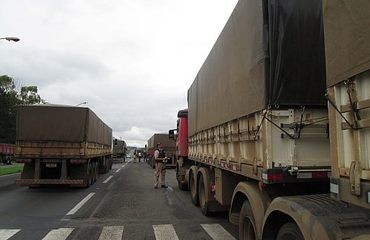
São Paulo – Brazil is down 20 positions in the Logistics Performance Index (LPI) compiled by the World Bank. The country ranks 65th on a list of 160 countries released this Thursday (20th) by the organization. In the last edition, released in 2012, Brazil ranked 45th. The list is part of the survey Connecting to Compete 2014: Trade Logistics in the Global Economy.
The index measures how countries have performed in different areas relating to the flow of goods, such as freight forwarding, transport infrastructure quality, timely deliveries, freight costs and others.
To the World Bank, there is an “almost universal recognition that poor supply-chain efficiency is the main barrier to trade integration in the modern world.” According to the bank, the evaluation criteria are increasingly recognized as “important to development.”
“The LPI is trying to capture a rather complex reality: attributes of the supply chain,” said disse Jean-François Arvis, senior transport economist and founder of the LPI project. “In countries with high logistics costs, it is often not the distance between trading partners, but reliability of the supply chain that is the most important contributor to those costs,” he added. In other words, efficient logistics constitute a competitive edge.
In the case of Brazil, the trade specialist Daniel Saslavsky, a member of the team ersponsible for the index, said all six LPI components have declined compared with the 2012 report.
“Brazil shows a negative trend in performance, but other countries’ performance also impacts the country’s ranking. Several countries improved in 2014 as compared to the last edition, and that tended to push Brazil’s ranking down, Saslavsky told ANBA by email.
Brazil scored 2.94 in the index this year, as against 3.13 in 2012; This year’s score is equivalent to 62.3% of the score of Germany, the top-ranking country. Saslavsky added that the result echoes the sentiment of the evaluations provided by Brazilian freight forwarders, which rank several aspects of the logistics environment in their own country. The survey covered over 1,000 industry professionals worldwide.
“Compared to 2012, a higher percentage of respondents indicate that rates and charges paid for logistics services are high, and that the quality of the infrastructure is low,” said the specialist. “Moreover, border clearance times have substantially increased based on the view of Brazilian,” he said.
Among the Brics, Brazil only fared better than Russia, which placed 90th. Compared with the Arab countries, Brazil ranks lower than the United Arab Emirates, at 27th, Qatar (29th), Saudi Arabia (49th), Bahrain (52nd), Kuwait (56th), Oman (59th) and Egypt (62nd). An Arab country, Somalia, is at the bottom of the global list. In the first two editions of the LPI, Brazil placed 61st, in 2007, and 41st, in 2010.
The World Bank informs that the gap between top- and bottom-ranking countries is still quite large, despite a slow convergence since 2007.
The bank notes that the gap persists because of the complexity of logistics-related reforms and investment in developing countries. Nonetheless, generally speaking, there has been some improvement.
*Translated by Gabriel Pomerancblum

