



São Paulo – Brazil is faced with the difficult task of going back to growth amid a scenario of inflation, high interest rates, and mistrust from local and international investors alike. To succeed, the government must roll out a series of fiscal measures that can no longer be postponed, including spending cuts and a Social Security reform.
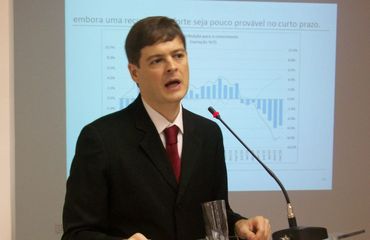
So says Paulo Val, chief economist of the asset management division at the bank Brasil Plural, who delivered the lecture Economic Scenario and Foreign Exchange Trading this Wednesday (3) at the Arab Brazilian Chamber of Commerce in São Paulo. He spoke alongside the bank’s officer Bruno Gargiolli.
“A spending limit is paramount, as is the Social Security reform. I think these are the two major reforms that will change the way the fiscal [reform] has been taking place lately. The other measures that are needed are more topical ones, but those two will cover a much wider spectrum, and they will help lay the groundwork for years to come,” said Val.
“Then you have the issue of accessibility to benefits, and even minimum wage raises need discussing – whether a real minimum wage raise should happen – and the issue of part of of the population being entitled to several social benefits, whether that should continue or not,” he pointed out.
According to Val, Brazil is experiencing a scenario unlike those of developed countries. In the United States, for instance, where unemployment is relatively low, an interest rate hike is expected – the current rate varies from 0.25% to 0.5% per annum. Europe’s economy, Val said, is also on an upward curve. Here in Brazil, he noted, the government is being urged to slash an interest rate that’s now 14.25% per annum, while preventing inflation – which is seen closing at 7.21% this year – from rocketing even further.
“It looks like the government’s outlook has grown more constructive and positive. They are aware that reforms are needed; now it’s down to implementation. If they don’t deliver on the reforms, then we might see the scenario deteriorate again,” he offered.
The economist also touched on how instability in Brazil has eaten away at foreign investor confidence, leading the real, the national currency, to lose strength. “Foreign exchange markets are a good indication of how foreign investors are seeing Brazil,” he said. For him, the next measures to be taken by Brazilian government in order to get its finances in order will be key in dictating how investors will approach the country.
“The fiscal scenario will determine how optimistic investors will be regarding Brazil. And that means not only portfolio investors, the ones who invest in the stock exchange, in government and corporate bonds, but also those who invest in real assets. It will dictate the extent to which people will be willing to buy a company here, to make new investments here,” he pointed out.
And since the government has not defined its fiscal adjustments yet, Val doubts that Brazil’s economy will see strong growth next year. “Growth should be around 1% next year,” he said. However, if the economy shows solid improvement in the second half of 2016, Val claims 1.8% growth could be a possibility in 2017.
For the economist, the first steps towards economic recovery in Brazil “have already been taken.” “For example, industry has grown in the second quarter from the first one. That is something that hadn’t happened in a long time. So the first step to economic normalcy is underway. Now, it’s a long, progressive walk. The fiscal [adjustment] is what will truly provide the strength to those steps, and the strongest they are, the faster the journey will be,” he concluded.
Forex trading
Bruno Gargiolli discussed the services offered by Brasil Plural, emphasizing foreign exchange settlement operations, and hedging mechanisms for exporting and importing companies. He explained the options available to clients to protect their foreign sale and purchase operations from fluctuations in the US dollar.
Established in 2009, Grupo Brasil Plural comprises seven different businesses, including the bank, asset management businesses such as equity funds and private funds, asset management, and a brokerage firm.
“By July this year, our foreign exchange trading had reached BRL 5.3 billion, which is nearly double the amount we traded in 2015,” Gargiolli revealed. According to the executive, the bank has over 350 active clients, including natural persons and corporate clients.
According to the manager, the bank’s unique features include competitive costs and fees, speedy analysis and approval of operations, one-on-one services, and easy-to-reach partners.
*Translated by Gabriel Pomerancblum

