



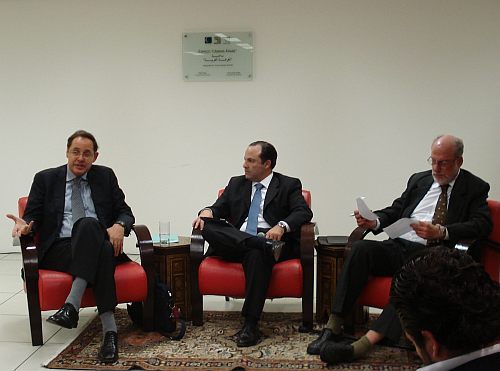
São Paulo – Economist Eduardo Giannetti da Fonseca gave a talk on perspectives for the Brazilian economy at the Arab Brazilian Chamber of Commerce on Tuesday (20) evening. To him, the current scenery should not change much, at least until the second half of 2014, when the next election for president should take place. “I see no chance of change in the short run,” he said, to an audience of businessmen and consultants, as well as Arab Brazilian Chamber employees and directors. From then on, Giannetti added that it is too “early” to make forecasts.
That does not mean that the near future will be good, as the current picture of the economy, in his evaluation, is far from ideal. He pointed out the three main problems in Brazil: low growth, inflationary pressure and a great current account deficit. “A combination of these three factors is not common,” he stated.
In the economist’s opinion, inflation and expansion of the foreign deficit are compatible with a framework of fast growth. Currently, the negative balance in current account transaction is 3% of Gross Domestic Product (GDP), while GDP grew only 0.6% in the first quarter of 2013, as against the last quarter of 2012 and the Broad Consumer Price Index (IPCA), the inflation index calculated by the government, was 6.27% over the last 12 months. In the 12 months up to June, inflation was above the 6.5% ceiling of the target established by the Central Bank, but it dropped a little last month.
“This situation is not at all comfortable,” pointed out Giannetti. To him, “the potential GDP of Brazil had been overestimated.” That means that forecasts made in the recent past, which pointed to annual growth of between 4% and 4.5%, were excessively optimistic and have been frustrated in recent years. According to the economist, if the country’s economy grew on average 4% a year from 2003 to 2010, the performance over the last three years, well below that, allows for an estimate of future growth of 2.5% to 3%, “in a sustainable manner”.
He declared that over the last decade the country had significant advances. In the first place, there was significant growth in the price of export commodities like grain and ore, mainly prior to the international financial crisis, but also after it, with the appetite of emerging markets, especially China. Domestically, social policies and the heated economy caused 30 million people to climb to the middle class, unemployment dropped by half and the economically active population grew on average 1.5% a year.
“This movement has run out,” said Giannetti. The North American economy is recovering, the crisis in Europe seems to be under control and the emerging nations are no longer growing as they were. On the other hand, this scenery reduces the international demand for products that Brazil exports, in turn, attracting to the United States the capital that had sought greater profitability in developing markets, generating a foreign deficit and depreciating local currencies. In the domestic area, the economist defends that there has been deterioration of Brazil’s economic policy, mainly after the start of the Dilma Rousseff government, in 2011.
To him, the “tripod” established by “fiscal austerity”, translated into primary surpluses, fluctuating exchange and independence of the Central Bank, marked by the effort towards inflation targets, was relaxed in recent years, in a policy that “lost sharpness” and consistency.
The economist also criticizes punctual measures turned to solving macroeconomic problems, which he called “micromanaging the economy”, like the tax breaks granted to specific sectors with greater pressure on the government; greater or lesser import tax on certain products, sometimes to protect a sector, other times to prevent price hikes; the control of public tariffs, as is the case with electric energy, hoping to control inflation; and the changes in the model for concession of public services to the private initiative.
Giannetti said, however, that “there is a learning curve”, which shows that the government seems to be learning with its recent errors, and one example is the “Central Bank’s change in posture”, after it returned to raising the benchmark interest rate and seems more concerned with the inflation target.
Another positive figure is unemployment, which continues below 6%, which the economist qualifies as “spectacular”. He says, however, that the rhythm of job generation should drop with the slowdown of the economy.
Bottleneck
Another Brazilian problem, according to Giannetti, a structural bottleneck that has been present since the 1988 Constitution, is the low investment in the formation of gross fixed capital, that is, investment in infrastructure and in the productive sector itself. The rate in Brazil is around 18% of GDP, while in other countries “with high performance of investment” it ranges from 25% to 30%.
This low level of investment is partly due to the high tax burden of Brazil, 36% of GDP. On the other point, state-owned investment is just 2.4%. That is, in practice it is money that the government removes from the economy to fund the public sector and that does not generate benefits to the same extent.
Mercosur
On answering a question by Arab Brazilian Chamber president Marcelo Sallum, Giannetti also spoke about the Mercosur, which is living a difficult moment, with Paraguay still suspended, the entry of Venezuela and deterioration of the Argentine economy. “Our partners are very lacklustre,” he said. “Brazil must think more about trade agreements with other relevant blocks, like North America and the European Union, than insisting in this process that did not work out, the Mercosur,” he added.
The debate, with questions by the audience, was mediated by Sallum and by Mario Rizkallah, a businessman and former director at the Arab Brazilian Chamber.
*Translated by Mark Ament

