



Brasília – The Brazilian government has announced this Thursday (20th) that the 2014 Federal Budget cut will amount to R$ 44 billion (US$ 18.3 bn at current exchange rates). With the cut, the government is aiming for a primary surplus equivalent to 1.9% of the Gross Domestic Product (GDP), in a bid to keep solid macroeconomic foundations and maintain the confidence levels of international investors and the domestic market alike.
The R$ 44 bn cut is higher than 2013’s R$ 38 bn (US$ 15.8 bn), but lower than those of 2012 (R$ 55 bn – US$ 22.9 bn) and 2011 (R$ 50.1 bn – 20.9 bn). Out of the total cut, R$ 13.5 bn (US$ 5.6 bn) concern mandatory expenditures, and R$ 30.5 bn (US$ 12.7 bn) concern discretionary expenditures.
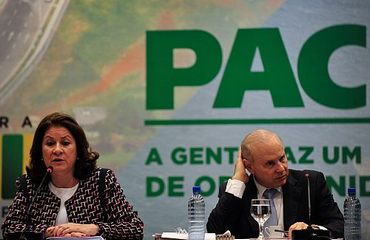
To Brazil’s Finance minister Guido Mantega, the cut has sent a good signal to the domestic and foreign markets, considering the international economic turmoil underway. He said increased optimism from economic players regarding Brazil should ensue after the cuts.
The government’s forecasts were based on the following parameters: a primary surplus equivalent to 1.9% of the GDP, equivalent to R$ 99 bn (US$ 41.3 bn); a 5.3% inflation rate, and dollar-to-real ratio of 1 to 2.44.
The Brazilian ministries of Health, Education, Social Development, and Science and Technology were spared from the 2014 Budget cuts. These four areas are regarded as priorities by the government.
The budget forecasts for these four ministries are as follows: slightly above R$ 82.5 bn (US$ 34.3 bn) for Health, R$ 42.2 bn (US$ 17.6 bn) for Education, R$ 31.7 bn (US$ 13.2 bn) for Social Development and R$ 6.8 bn (US$ 2.8 bn) for Science and Technology. All of the amounts are higher than the budget allocations in 2013.
“The tools we have employed include cutting cost-related spending, increasing investment and maintaining social programs,” said Mantega.
Out of the R$ 30.5 bn (US$ 12.7 bn) cut in discretionary expenditures, i.e. those whose allocation the government has autonomy to decide upon, R$ 13.3 bn (US$ 5.5 bn) consist of formerly forecasted expenditures on amendments to the Federal Budget Law. The budget earmarked to amendments has dropped from R$ 19.76 bn (US$ 8.2 bn) to R$ 6.46 bn (US$ 2.6 bn).
The Growth Acceleration Program (PAC, in the Portuguese acronym) saw the second sharpest cut, after amendments: R$ 7 bn (US$ 2.9 bn) – from R$ 61.46 bn (US$ 25.6 bn) to R$ 54.46 bn (US$ 22.7 bn).
Translated by Gabriel Pomerancblum

