



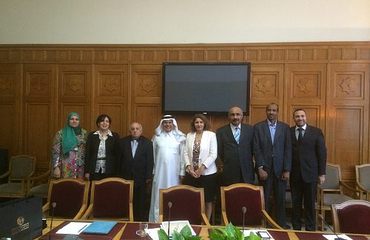
São Paulo – The Arab Brazilian Chamber of Commerce presented to the League of the Arab States, this Monday (25th), in Cairo, the project for an online system for certification of origin and legalization of export documents which promises to reduce costs and shorten time for these services. The Arab Chamber is the only organization in Brazil authorized by the Arab League to carry out the process of certification of origin and documents in exports to the Arab world. The legalization, however, is carried out by the embassies and consulates of the countries in the region.
The proposal was presented by the Arab Chamber’s CEO, Michel Alaby, and Government Relations manager, Tamer Mansour, to the Arab League’s joint secretary general for Economic Affairs, Mohammed Al-Tuwaijri, and the head of the IT area of the multilateral organization, Ramy Abdallah.
According to Alaby, Tuwaijri agreed that technology cuts down time, costs and paperwork, and asked if the system is exclusive to the Arab Brazilian Chamber, or if it could be applied to other Arab Chambers of Commerce. “One of the issues of the utmost importance to the Arab League is the possibility to electronically access and obtain reports of exports and imports divided by country,” said Alaby.
According to the Arab Chamber’s CEO, the reports will be accessible not only by the League, but also by customs officers in Arab countries, for monitoring import prices and volumes. Another meeting to discuss the implementation of the system will be held later this week.
Alaby and Mansour will now join the Brazilian delegation led by the Agriculture minister, Neri Geller, which was in Iran and arrives this Tuesday (26th) in Cairo.
Iran lifts embargo
According to information from the news agency Agência Brasil, the visit to the Persian country has proved fruitful, as Iran has lifted the embargo on meat produced in the Brazilian state of Mato Grosso. Geller and his Iranian counterpart, Mahmoud Hojjati, convened on Monday.
In Egypt, Geller will meet with the Egyptian Agriculture minister, Adel El-Beltagy, on Thursday (28th), to tackle the same issue. The Egyptian government has also embargoed meat imports from Mato Grosso.
Both countries suspended imports after the causative agent of the Bovine spongiform encephalopathy – mad cow disease – was found in an animal located in Mato Grosso.
The case was considered “atypical”, as, according to the Mapa, the animal died of old age rather than infection. Brazil’s mad cow disease risk status remains negligible, according to the World Organisation for Animal Health (OIE, in the French acronym).
The Mapa’s International Relations secretary, Marcelo Junqueira, told ANBA in an interview last week that the delegation wanted to show the governments of both countries that “Brazil’s animal health is on par with the best in the world” and that most markets that had banned imports after the occurrence of the case have already resumed purchasing.
*Translated by Rodrigo Mendonça

