



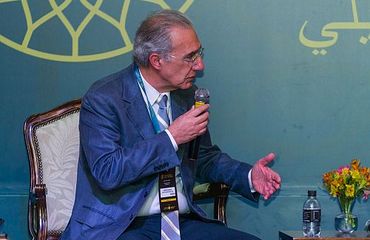
São Paulo – The Arab Brazilian Chamber of Commerce Foreign Trade vice president Rubens Hannun delivered a lecture about the markets and consumption habits of Islamic countries this Friday 11) in Brasília, in the final day of the course “The Islamic World,” offered by the Federation of Muslim Associations in Brazil (Fambras) at Instituto Rio Branco, the diplomatic academy of the Brazilian Ministry of Foreign Affairs.
Hannun went over the current scenario, market size and demographic makeup of Muslim countries, including the fact that most of their populations are young, and trends such as the rising demand for halal goods and services, i.e. those that observe Islamic tradition.
“We try to show the communicational challenges that securing a foothold in those markets entails,” the VP said. “We also covered economic diplomacy,” he added.
In this regard, Hannun underscored the work done by the Arab Chamber, which carries out promotional actions, in addition to doing intensive work with governments, chambers of commerce and other business organizations across the Arab world, in order to build ties between Brazil and the region.
He stressed that the Chamber advises Brazilian business owners to show respect towards Arab culture and to build a personal rapport prior to engaging in actual business transactions.
He used numbers to show that Brazilian products are climbing the ranks when it comes to the taste of Arab consumers.
In Dubai, United Arab Emirates, there’s an Islamic economy center that publishes a ranking of halal products and services supplier countries. Overall, according to him, out of 73 countries surveyed, Brazil climbed from the 25th to the 23rd position from 2015 to 2016. Specifically in the foodstuffs sector, the country went from 6th to 4th place.
In addition to this there’s the good diplomatic relations that Brazil traditionally holds with Arab nations and the empathy that the Brazilians have for Arabs, as a research conducted recently by the Arab Chamber has shown. To conclude, Hannun highlighted business opportunities for Brazilian companies in the Islamic market.
At the end of the course, lawyer Edgard Raoul gave a testimony on his experience living with refugees in the Middle East. The programme ended with the dean of the Council of Arab Ambassadors in Brasil and also Palestine’s ambassador, Ibrahim Alzeben, the director-general of the Rio Branco Institute, José Estanislau do Amaral Souza Neto, and the head of the Middle East Department of the Brazilian Ministry of Foreign Affairs (Itamaraty), Lígia Maria Scherer.
*Translated by Gabriel Pomerancblum and Sérgio Kakitani

