



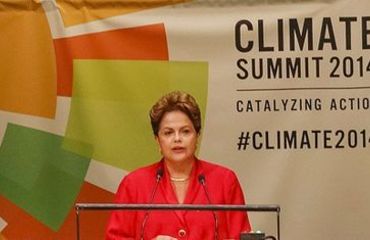
Brasília – This Tuesday (23rd) at the Climate Summit, in New York, USA, Brazil’s president Dilma Rousseff spoke for a global effort to galvanize investment for fighting climate change, and stated that Brazil is proof that economic growth and environment preservation are not contradicting goals.
“The costs of fighting climate change are high, but the benefits are more than worthwhile. We must reverse the logic that fighting climate change comes at the expense of the economy. Emission cutting and adaptation actions must be acknowledged as sources of wealth that attract investment and underpin new actions in sustainable development,” Rousseff said during the meeting.
The summit, called for by United Nations (UN) secretary general Ban Ki-moon, takes place one day prior to the 69th UN General Assembly. Despite speaking for global investment, Rousseff stressed the principle of “common but differentiated responsibilities” that drives UN climate negotiations. She noted that the growth of developed countries has been fuelled by high greenhouse gas emissions.
“We do not wish to replicate this model, but we will not relinquish the imperative of reducing inequality and raising the living standards of our people. We, the developing countries, have equal rights to well-being, and are proving that a socially fair, environmentally sustainable model is possible,” she asserted.
The president cited measures taken by the Brazilian government in the last few years to cut down greenhouse gas emissions, especially those relating to deforestation in the Amazon.
“Over the past ten years, deforestation in Brazil was reduced by 79%. From 2010 to 2013, we refrained from releasing an average of 650 million tonnes [of greenhouse gases] per year into the atmosphere,” she said. “Brazil’s voluntary reductions contribute significantly to reducing global emissions in view of 2020. Brazil does not announce promises, it shows results,” she added.
Regarding the new global climate agreement, which should be signed at the 21st Conference of the Parties on Climate Change COP-21), next year in Paris, Rousseff said Brazil champions an ambitious draft, so long as it respects the differences between rich countries and developing nations.
“The new climate agreement must be universal, ambitious and legally binding, while observing the principles and clauses of the [UN’s] framework convention, especially the principles of equality and of common but differentiated responsibilities. This agreement must be robust in terms of mitigation, adaptation and implementation,” she pondered.
*Translated by Gabriel Pomerancblum

