



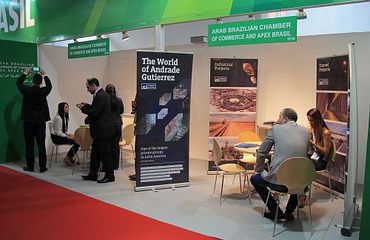
Erbil, Iraq – Brazilian companies exhibiting at the 9th Erbil International Fair, which started this Monday (23rd) in the capital of the Kurdish region of Iraq, are aware of the potential of the region and the country, and are looking to place themselves as an alternative to established suppliers from Turkey, Iran, and China.
The Brazilian construction company Andrade Gutierrez, for instance, has signed a protocol of intentions with the Iraqi Ministry of Transport to work in partnership with the country’s government, according to the company’s business development manager in Iraq, Ali Toufic Raad, who is Brazilian, despite his name. “We are hoping to have a contract for transportation soon,” he said.
According to him, Iraq plans on investing heavily in infrastructure. After decades of conflict, the country has vast shortcomings in the sector. “We are confident that we can make a contribution to the development of Iraq and to further cementing the country’s relations with Brazil,” he said.
He noted, however, that though promising, the market is riddled with strong competition from Turkey, Iran and China. The Brazilian heavy construction industry, however, is well reputed in Iraq due to past work done by companies like Mendes Junior.
Companies in other industries are attending the fair to prospect the market. One of them is the São Paulo-based KRJ, which manufactures connectors for power distribution networks. “We are trying to expand our business in the Middle East,” said Mauro Vicente Filho, of the commercial department, alongside the company’s representative in Lebanon. Usama Richani.
Vicente wants to learn about the functioning of the local electrical network. “We want to know which products are best suited,” he said. The company does business in Lebanon and Jordan, and its items are approved for sale in Dubai, United Arab Emirates. “We are hoping to sell from US$ 1 million to US$ 1.5 million a year in the Middle East,” he added.
Getting to know the market is also the goal of Angraex, a marble and granite manufacturing company in the Brazilian state of Espírito Santo. “We are looking to ascertain whether there is a market for Brazilian stones,” said the sales executive Danielle Ervatti. “They do have a market for granite, however they buy mostly from China and India,” she said. The idea, Ervatti explained, is to check whether the company can compete, price-wise, and whether the Iraqi market is interested in “more exclusive” product.
*Translated by Gabriel Pomerancblum

