



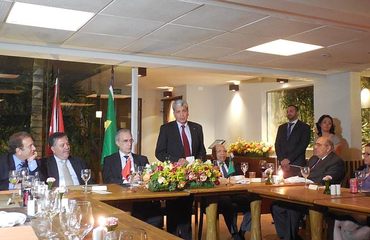
São Paulo – The Brazil-Tunisia Business Council is active again with the appointment, this week, of new members and duties. This Wednesday (6th) night, the presidents of the collegiate, Rubens Hannun, for the Brazilian side, and Hassine Bouzid, from Tunisia side, signed a declaration that marks the reactivation of the group.
“We are drafting a target and goals plan to start 2016, in Tunisia, already showing some concrete results”, said Hannun, who is vice-president of Foreign Trade at the Arab Brazilian Chamber of Commerce and Tunisia’s honorary consul in São Paulo. He was talking about the council’s next meeting, scheduled for next year in Tunis.
Among the goals set by the collegiate are the trade expansion and diversification, the strengthening of bilateral cooperation, the encouragement of partnerships and the promotion of reciprocal investments. For this, the body must encourage the participation of businessmen in fairs and other business events in both countries, carry out trade missions, exchange information, organize business meetings, promote the “Tunisia Brand” in Brazil and vice versa, among other duties.
“We are committed to achieve a lot of things, such as facilitate the networking [among businessmen], consolidate and diversify the relations between the countries”, declared Bouzid, who was Tunisia’s ambassador in Brasília from 2000 to 2005. “In the situation report [to be released in 2016], I hope to see an increase in volume of trade exchange, both in 2015 and 2016, but also the start of industrial cooperation. And why not in the pharmaceutical sector, which is very important to Tunisia?”, he added.
The pharmaceutical industry is thought of as promising for business between the two countries, so much so that the Brazilian Association of Pharma Chemicals and Pharmaceutical Raw Material (Abiquif) and the laboratory Eurofarma are new members of the council.
According to Eurofarma’s executive director, Walker Lahmann, the company is planning to take its operations to Africa and considers Tunisia as an option for a plant. “That’s why we are here”, he said. In his assessment, the North Africa nation draws one’s attention due to its business environment and stability. The country is the only one in the region that was able to sustain a democratic transition after the Arab Spring in 2011. Eurofarma already owns plants outside Brazil, in Latin America.
Delegation
The re-launching of the council occurred during the visit of a Tunisian delegation to São Paulo comprised by businessmen, representatives of sectorial entities and the government. Some members of the delegation were exhibitors at the Supermarket Association of São Paulo State (Apas) fair, which ends this Thursday (7th).
Tunisia’s ambassador in Brasília, Sabri Bachtobji, pointed out that the work done by the Arab Chamber in the promotion of bilateral business “has yielded results”. He noticed, for instance, that the Tunisian participation at Apas’ previous edition, in 2014, “was more modest”.
The deputy general director of the Export Promotion Center (Cepex), Riadh Attia, had a positive assessment of the delegatoin’s schedule, which included a seminar at the Arab Chamber’s headquarters and visits to companies. According to him, there’s a willingness of Brazilian businessmen to deal with Tunisians and some sectors were identified as having a great exploring potential, such as agriculture and food products, especially the olive oil industry – which is very important in Tunisia –, auto parts and medicines.
“These are sectors in which Tunisia has competitive advantages”, declared Attia. He added that the geographic location and trade agreements already in place facilitate the trade of goods produced in the country with other Africa and Middle East nations, besides the European Union. “We need to open new outlooks on cooperation, diversify the agenda, since on both sides it’s too concentrated in basic products”, he said. As an example, the executive pointed out the exports of phosphate from Tunisia to Brazil, which declined and significantly impacted bilateral trade revenues. “We need to identify other products and expand the exchange”, he emphasized.
Cepex owns a spot in the council from the Tunisian side, just as the Agency for Agricultural Investment Promotion (Apia) of the Arab country. According to Hammami Sihem, responsible for Apia’s communications, the institution wants to promote partnerships between Brazilians and Tunisians in sectors such as olive oil, dates, meats and dairies. “Brazil is more advanced than we are in the area and we want their support for Tunisia’s agriculture, to modernize and promote the sector”, she said.
She talked to Brazilian companies that participated of Apas to revive the interest of doing business with Tunisia and of eventual investments. The agency wants, for instance, to attract companies – including agriculture machinery suppliers – to Brazil to visit and exhibit at the International Exhibition of Agricultural Investments and Technology (Siat), which will take place next year in Tunis.
The Brazil-Tunisia council was created in 2002, but hadn’t met for a few years already. From now on, the idea is to schedule one meeting per year, alternating the host country. In the Brazilian side, the coordination is being managed by the Arab Chamber, and in the Tunisian side, by the Tunisian Union of Industry, Commerce and Handicrafts (Utica).
*Translated by Sérgio Kakitani

