



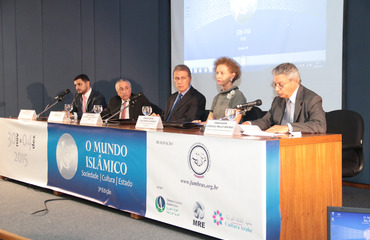
São Paulo – The Federation of Muslim Associations in Brazil (Fambras) held this week at diplomacy school Instituto Rio Branco, in Brasília, the third edition of the course O Mundo Islâmico (The Islamic World), in partnership with the Brazilian Ministry of Foreign Relations. “One of the goals is to try to bring in-depth knowledge on Islamism to public policymakers who often lack a clear perception of the subject,” said Fambras vice president Ali Hussein El Zoghbi.
Although the course targeted diplomats who work with Arab and Islamic countries, Zoghbi remarked that a relevant amount of personnel from different ministries attended, including Defense, Health, Education, the Central Bank etc.
“These people are somehow involved with Muslim issues or Islamic countries,” he said. “[The program] perfectly suits a range of people avid for more knowledge [on the topic],” he added.
He explained that the course approached Islam from different perspectives, including history, philosophy, sociology, anthropology, geopolitics, economics, finance and markets. “I don’t see another way; one in four people in the world is a Muslim, hence the importance of learning about Muslims and Islamism,” he said.
Zoghbi said that from an economic standpoint, one cannot overlook the size of the Muslim consumer market, and when it comes to international peace, they cannot be left out of the discussion either.
The rise of the self-proclaimed Islamic State and the Paris attacks on November 13th, the course gained even more importance. “Since there is an extremist group committing atrocities in the name of religion, [the course] has become all the more important,” he said. Zoghbi stressed that the content is meant to “undo this connection.”
Fambras’ vice president believes there is more space in the press and other forums today for the opinion of the followers of Islam and for Muslim organizations to “manifest that these barbaric actions bear no connection whatsoever with religion.” Proof of that is the fact that in 2016 the federation will host an edition of the course in São Paulo for journalists, at the request of the professionals, according to Zoghbi.
Book
The Brazilian Foreign Ministry also plans on releasing a book in 2016 summarizing the course’s contents. Each lecturer submitted a text on their specific subjects to be included in the edition. Rio de Janeiro is hosting the Olympic Games next year, therefore the country needs to welcome people from different places, and this also leads to heightened interest in the matter.
Lecturers included Zoghbi himself, professors Paulo Hilu of Universidade Federal Fluminense (UFF), Jamil Iskandar of Universidade Federal de São Paulo (Unifesp), Andrew Patrick of Centro Universitário Unicuritiba, Beatriz Bíssio of Universidade Federal do Rio de Janeiro (UFRJ), Gisele Fonseca Chagas of UFF, Mohamed Habib of Universidade de Campinas (Unicamp), Hussein Kalout, a researcher at the Weatherhead Center for International Affairs of Harvard University, the president of the Institute of Arab Culture (Icarabe), Salem Nasser, the regional manager for Latin America at the National Bank of Abu Dhabi (NBAD), Angela Martins, and the Foreign Trade vice president of the Arab Brazilian Chamber of Commerce, Rubens Hannun.
*Translated by Gabriel Pomerancblum

