



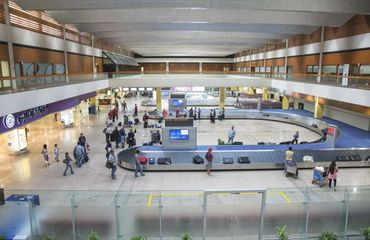
São Paulo – Dubai International Airport (DXB) received 7,662,946 passengers in April, an increase of 9.2% compared to the 6,979,063 passengers in the same month of last year, according to the Emirates News Agency (WAM), in a report that mentions data made available this Monday (29) by Dubai Airports, the airport’s operator.
In the year’s first four months, the volume of passengers in the airport reached 30,119,542 people, a volume 7.9% higher than the first four months of 2017, when passenger traffic stood at 27,926,958 people.
According to WAM, South America registered the highest percentage growth in April, with 38.9% more passengers over the same month of 2016. April was the first month of operations of the Airbus A380 in the São Paulo-Dubai route by Emirates Airlines. Eastern Europe, with 33.9%, and Asia, with 18.9%, presented the second and third largest growth, respectively.
In terms of volume, the best performance belonged to the Indian subcontinent with 1.694 million passengers, followed by West Europe with 1.677 million, and the GCC with 1.3 million. London was the city with the highest volume of passengers to DXB with 350,000 passengers in April, followed by Doha with 290,500, Jeddah with 196,700, Bangkok with 192,900, and Mumbai with 191,200 passengers.
In April, DXB registered 35,300 flights, 1% more than the 35,000 in the same month of last year. But the average number of passengers per flight increased 7.1%, going from 210 to 225 in the same comparison.
Cargo handling went up 1.9% in April 2017 over the same month in 2016, going from 213,800 tons to 217,800 tons. In the first four months, the increase was of 3.1% with 854,000 tons of cargo handled from January to April, against 828,900 tons in the first four months of last year.
According to Paul Griffiths, CEO of Dubai Airports, the growth seen in the first four months was satisfactory. “With the Islamic festival of Eid Al Fitr (end of Ramadan) coinciding with start of the summer holidays next month, we are confident the numbers will boost our performance in the first half,” he said.
*Translated by Sérgio Kakitani

