



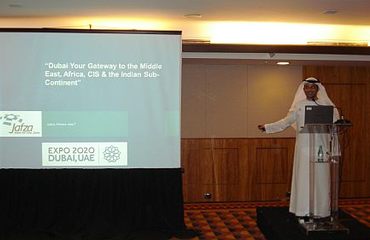
São Paulo – Dubai, in the United Arab Emirates, is like a big supermarket or a shopping mall, where one can find companies from around the world looking to buy and sell a whole bevy of goods. It was thus that delegates from the Jebel Ali Free Zone (Jafza), located in the emirate, introduced the city as an international business hub during a seminar to promote the facility this Monday (28th), in São Paulo.
“Dubai is a like a big supermarket, the supermarket of the Middle East,” said the Jafza senior vice president for sales, Adil Al Zarooni, to an audience mostly comprised of businessmen, executives and consultants, at the Renaissance hotel in São Paulo. The event was sponsored and featured the Arab Brazilian Chamber of Commerce and the Brazilian Export and Investment Promotion Agency (Apex-Brazil).
“If you can sell in the Emirates, you will sell in the Middle East,” Zarooni added, highlighting the opportunities that can present themselves to Brazilian companies once they set up subsidiaries in Dubai.
The Jafza senior sales manager for the Americas, Ahmad Bin Harib, was even more emphatic. He noted that the United Arab Emirates moves US$ 580 billion a year in bilateral trade, and that the country’s Gross Domestic Product (GDP) is US$ 390 billion.
“Our trade flows are higher than our PIB. This is proof that we are indeed the region’s shopping mall,” said Harib. “If you want the Middle East, you must be in Dubai,” he claimed.
Housing 7,300 retail, industry and logistics companies, Jafza contributes US$ 90 billion to the country’s foreign trade, and the 62 Latin American companies operating there gross a combined US$ 1.5 billion. More than half the amount, or US$ 820 million, is accounted for by the 12 Brazilian companies with operations in the free zone.
The advantages the Jafza offers in order to attract foreign companies include tax exemption, total freedom for remittances, unrestricted hiring freedom, 100% ownership rights, all paperwork taken care of in one single site, and a vast access network by air, sea and land to other countries in the Middle East, Africa and Asia.
Harib also highlighted the ease of the “logistics corridor” composed of Jafza, the Jebel Ali Port and the neighbouring World Central Airport. According to him, companies operating from the free zone can unload their goods off a ship and route them to another country by plane, with no need for customs or checkpoint clearance.
In order to support Brazilian companies, the Apex has a business centre at the free zone. According to the Jafza internationalization manager Juarez Leal, the agency offers services such as support to companies in setting up operations, market intelligence and commercial promotion.
The Arab Chamber international business executive João Paulo Paixão added that the organization also offers different services to Brazilian companies interested in that market, such as document certification, translation, research, contact with potential business partners, participation in fairs and trade missions. “There is certainly no lack of support to Brazilian companies looking to go to the Arab market,” he noted.
Those who have been there can attest to that. Alexandre Vasto, of MCassab, a Brazilian multi-sectorial company with operations at the Jafza, said the company’s Dubai operations are wholly focused on cosmetics supplies, and spoke highly of the facility. “There are no caveats, what they say is what you get, pure and simple. Dubai is an oasis of peace in order for you to focus on your business.
Halal
The cosmetics area is actually one of the most promising in the country, next to the food sector, according to Zarooni. Likewise, he says that Jafza has just set up a hub for halal products, i.e those manufactured according to the Islamic rituals.
“Brazil is one of the big food suppliers in the world and in the Middle East. Brasil Foods (BFR), for example, is the leading meat company in the region, we are the premier target market for Brazilian poultry, and the cosmetics market is also on the rise. Dubai wants to be the world capital of the Islamic economy”, said the vice president of Jafza. According to him, 1.6 billion people are Muslim and the countries with Islamic populations have a combined GDP of US$ 8 trillion.
The Arab Brazilian Chamber vice president Rubens Hannun pointed out that trade between Brazil and the Arab world – and with the Emirates in particular – is maturing. He notes that the organization promotes constant actions in Dubai, such as participation in fairs and trade missions, since 1998 at least.
“This a maturation process shows Arabs how consistent these relations are”, the executive pointed out. In his opinion, the seminars Jafza is promoting in Brazil – an event will take place on May 5th in Rio de Janeiro (see information below) – are “another step towards relations with the Emirates.” Hannun also said that this Tuesday (29th), the Arab Brazilian Chamber will sign a memorandum of understanding with Jafza for increased cooperation between the organizations. "This is a good time for us to enter into this partnership”, he claimed.
Representatives from the Dubai Department of Tourism & Commerce Marketing, Emirates Airline and the Emirati consul-general in São Paulo, Saleh Ahmed Al Suwaidi, also attended the seminar. "The opening of a consulate general in São Paulo shows is testament to the city’s importance to the United Arab Emirates", the diplomat said.
Service
Jafza Road Show Rio de Janeiro
May 5th
JW Marriott Copacabana Hotel – Av. Atlântica, 2.600, Rio de Janeiro, RJ, Brazil
For further information or to enroll, send an email to: [email protected]
*Translated by Gabriel Pomerancblum & Rodrigo Mendonça

