



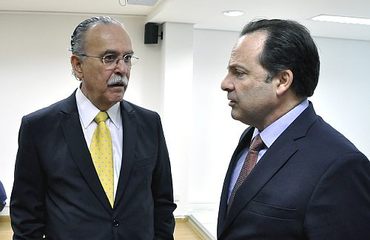
São Paulo – The economist José Roberto Mendonça de Barros, of consulting firm MB Associados, delivered a lecture this Monday evening (7th) at the Arab Brazilian Chamber of Commerce offices in São Paulo and recommended that business owners invest on exporting as the economy struggles. “Companies must redouble their efforts to sell abroad,” Mendonça told ANBA.
His view is that although the international scenario is not ideal, it is not bad either. Economic performance varies greatly from country to country. “Some are doing well while others are struggling,” he argued.
But Brazilian enterprises could take advantage of the strong US dollar to fuel their business overseas. The exchange rate hike means Brazilian-made goods are cheaper in dollars, so exporters accrue higher earnings when revenues are converted into domestic currency (the real). “Corporations need to work exports into their business plans,” the economist stressed.
Arab Chamber president Marcelo Sallum remarked that this movement toward exports is already underway. As a case in point, he cited the massive participation of Brazilian companies in Gulfood, the food industry expo held last month in Dubai, in the United Arab Emirates. “Exportation is a path that’s being taken by many companies,” Sallum said.
Mendonça believes foreign sales will increase as the year progresses, which is indeed the case so far, and that Brazil could register a trade surplus higher than USD 30 billion, in contrast with a USD 19.7 billion surplus in 2015 and a USD 4 billion-plus deficit in 2014.
On addressing Brazil’s current accounts, the economist pointed out that for the first time ever, the country is experiencing a strong economic turbulence “without a shortage of dollars.” Besides the trade surplus, he mentioned the high level of foreign exchange reserves (USD 370 billion, according to the Brazilian Central Bank) and the narrowing current account deficit, which is expected to shrink to zero this year.
Although economic performance varies from country to country, Mendonça said, for instance, that the United States are still a good market, despite the fact that growth of its Gross Domestic Product (GDP) is failing to meet expectations; China, is expected to increase its food imports, despite the fact that its economy is slowing, and that is directly advantageous to Brazil and the USA; and Argentina’s trade with Brazil may improve under the newly-inaugurated president Mauricio Macri, and this in turn should also help strengthen the Mercosur.
Domestically, the exchange rate could also benefit Brazilian companies by making imported goods pricier, including China’s.
Agriculture is the highlight
Brazil’s economy, however, is poised to perform poorly again, Mendonça believes. After contracting by 3.8% in 2015, GDP should shrink by at least the same rate again this year.
Agriculture will likely be the sole exception, he said; it grew 1.8% in 2015 and could see 2.2% growth this year. The economist heaped praise on the sector and said other industries could draw inspiration from it.
“The good news is that the agricultural industry chain keeps growing,” he asserted. “The reason is that productivity enhancement resides at the core of its business model. This is the only industry that strives to boost [productivity] even when it’s doing well and making money,” he added.
And that is achieved through a “permanent agenda of innovation,” with investment in science and technology. “As a rule of thumb, urban-based industries fail to accomplish that. That is a big lesson to industry,” he stressed.
Apart from focusing on foreign markets, the economist advised the executives in the audience to invest in innovation, adopt best practices and cut costs.
He also said now is a good time to buy assets cheap in Brazil, but warned they should not expect tax breaks or subsidized credit from the State, since the government’s tax revenues are dwindling.
Despite the shrinking revenues and the ensuing public deficit, Mendonça believes there is no chance that Brazil might default on its debt. That would take several years of calamitous economic performances. He even said he is telling his clients to purchase Treasury bonds as an investment option.
To the economist, the primary problem facing Brazil right now is lack of confidence in the economy, which stems from the political crisis underway. In such a scenario, business owners won’t invest because they fear not being able to sell their production, and consumers won’t buy because they aren’t sure they will be able to pay. “It’s a cycle that feeds back into itself,” he said. “The economic scenario is being largely determined by the political one,” he added.
*Translated by Gabriel Pomerancblum

