



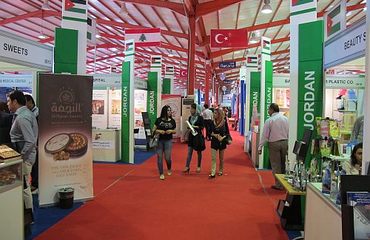
Erbil, Iraq – The 9th Erbil International Fair ended this Thursday (26th) in the capital of Kurdistan, in Northern Iraq. The Brazilian pavilion featured ten exhibitors, including the Arab Brazilian Chamber of Commerce, which organized the premises in partnership with the Brazilian Export and Investment Promotion Agency (Apex).
“It was better than we expected; we had over 150 visitors at the Arab Brazilian Chamber stand, and several requests were placed,” said the organization’s CEO Michel Alaby in the last day of the four-day event. According to Alaby, said requests included quotations for soya oil, peanuts, cotton, juices, fruit, foodstuffs in general, agricultural machinery, footwear and building material. The event is multisectorial.
The CEO highlights a project by a businessman interested in soybean oil. He wants to set up a canning plant. “He asked for canning machines, among other items,” Alaby said. The Arab Brazilian Chamber forwards the orders to the exhibiting companies, in case they offer the items in demand, and to the Chamber’s member companies.
Another participant pleased with the contacts made was the commercial manager for trading company West Food, Diogo Oliveira. “We had over 200 visitors, of which I believe 23 were serious, solid contacts,” he said. “It has been a positive experience, we must come again next year,” he added.
According to Oliveira, most visitors were seeking items such as sugar, coffee and beef, all of which his company supplies. “I am scheduling meetings and following up on the contacts via email; I believe we will do good business,” he said. “If the meat embargo ends, I believe there is a 100% chance [of orders being placed]. If it doesn’t, we will still have the other orders,” he said.
Iraq embargoed Brazilian beef imports following the Brazilian federal government’s announcement, last December, that the mad cow disease agent was spotted in an animal in the state of Paraná. The animal died in 2010, though not as a consequence of the condition, which it did not develop. The World Organisation for Animal Health (OIE) has since ruled that Brazilian product does not pose significant hazard to consumers, and that the risk of the disease occurring in Brazil is “insignificant.”
However, the issue has not been settled with the Arab country yet. Brazil is awaiting a technical mission from Iraq to try and solve the standoff. In order to showcase the quality of beef, the Association of Brazilian Beef Exporters (Abiec) held a barbecue at the Rotana Hotel, in Erbil, attended by local and international executives and diplomats. The roasted rump cuts, filet mignon, and ribeye steaks cooked by a chef from the Barbacoa restaurant, were met with much praise from satisfied guests. “The embargo is extremely harmful to us, because we already have clients here,” said Oliveira.
Showroom
Danielle Ervatti, the sales executive for the Espírito Santo state-based marble and granite company Angraex, got in touch with local construction companies and distributors. “Most people here are not familiar with our granite, they have never used Brazilian product; but they liked it, it’s all about negotiating the price,” she said. “Maybe something will happen.”
She said the local businessman suggested setting up a showroom with the company’s product in Erbil, and one of them spoke of forming a partnership. “If they provide the structure, then why not?” she said.
Mauro Vicente Filho, the commercial manager at KRJ, a São Paulo-based electrical connector manufacturing company, attended a meeting at the Kurdistan Regional Government’s Ministry of Energy. “We have the products [they need], their network is very similar to Brazil’s. We could update their technology,” he said. “They have requested further information. We will work on it, this was the first step,” he added.
In the medical industry, Fanem and Magnamed, both based in São Paulo, complain that the Iraqi government is restricting its tenders to enterprises based in the USA, Europe and Japan. However, they did pay visits to hospitals in Erbil. “They have no breathing apparatuses, so we stand a great chance, but we need a good agent [in order to introduce the product],” said Adnan Abaji, Magnamed’s representative for Arab countries. “I met people from a few companies that might help us break into the Iraqi market,” he said.
To Fanem’s regional manager for the Middle East, Abed Mihyar, good deals may go through, so long as the contacts are followed up closely. “Maybe if we come here again and go to more hospitals,” he said. “There is a strong demand, there are good opportunities, but we need to work hard,” he said. The company’s flagship is neonatal items such as incubators.
Image
To the business development manager at construction company Andrade Gutierrez, Ali Toufic Raad, who lives in Erbil, it is important to make the company visible to the general public. “It is our duty to participate in order to represent Brazil; it doesn’t matter whether it will yield results to the company,” he said. “Being at the Brazilian stand is aggrandizing to us, it makes us want to participate every year. It gives us visibility,” he said.
Next year, the Arab Brazilian Chamber CEO wants to change the strategy around a bit. In addition to attending the fair, he plans on arranging meetings with importers at the Erbil Chamber of Commerce and on scheduling visits to wholesale centres relating to the industries in which the participating companies operate. He scheduled a dinner next Thursday with the chairman of the local Chamber to discuss these matters.
There was some degree of frustration in the current edition due to the parallel agenda. There was expectation surrounding meetings between companies’ delegates and local authorities, but the fair took place shortly after the parliamentary elections in the autonomous region of Kurdistan, and therefore appointments with government officials could not be kept.
*Translated by Gabriel Pomerancblum

