



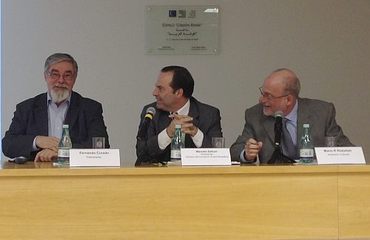
São Paulo – Out of every 100 family businesses, only 30 survive the transition from the first to the second generation, 12 make it to the third, and only eight reach the fourth. So said businessman and consultant Fernando Curado last Tuesday (14th) during his address on Corporate Governance and Family Business Succession Planning, held at the Arab Brazilian Chamber of Commerce headquarters in São Paulo.
“The transition proves traumatic,” said Curado. “One case in point is that of Indústrias Matarazzo,” he added, referring to one of the premier business conglomerates of 20th century Brazil, which did not survive the passage of generations.
Hence the need to plan out the succession and apply good practices in corporate governance, thus preventing the business from falling victim to family disputes and the personal interests of partners, or from hiring relatives. “Paying the light bill is not the job of the owner’s secretary job,” he said.
In that regard, in a well-executed succession, especially one involving several partners, the company keeps functioning apart from family issues, all the while ensuring shareholders’ earnings.
This requires selection of independent executives, the signing of a partnership agreement with shareholders that clearly states the partners’ powers and the bounds of management, process transparency, equal treatment to shareholders, accountability to partners, the setting of preconditions for family members to work at the company, etc.
Curado told the stories of four succession processes he was involved in, each with its own distinctive features. “Each case is different,” he said.
In one of these companies, for instance, the elderly owner did not regard any of his sons as candidates to succession, and was keen on selling the business. The sons, on the other hand, did not want the father to let go of the company. The problem is, the company’s success revolved around the figure of the owner. “The [business] strategy must be taken out of the founder’s head and made formal [as a strategy to be observed even in his absence],” he said.
Another important issue, said Curado, is to train the second and third generations to be shareholders. That is, even if the heirs never come to participate actively in the company, they must be educated on how to be partners whose decisions can affect the wealth of the entire family. That entails being familiar with the business, possessing managerial knowledge, and being aware of the shareholder’s duties and rights.
The talk was attended by businessmen, lawyers, consultants, directors and Arab Brazilian Chamber employees. The event was presented by the Chamber’s president Marcelo Sallum and former director Mário Rizkallah, who is in charge of organizing events of this kind.
This year, the Arab Brazilian Chamber is back to hosting regularly held talks on different subjects, as it has done in the past. In April, the economist José Roberto Mendonça de Barros discussed perspectives for the Brazilian and international economies. On June 4th, at 7:00 pm, human resource consultant Eline Kullock will address the coexistence of different generations within one single company.
*Translated by Gabriel Pomerancblum

