



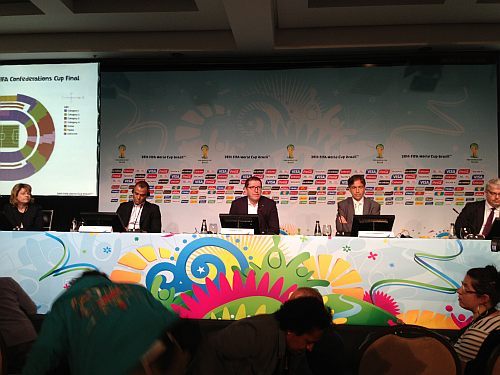
São Paulo – The International Football Federation (FIFA) announced on Friday (19) the prices and ticket sales dates for the 2014 World Cup, at a press conference in Sao Paulo. Tickets will be sold to the general public from R$ 30 to R$ 1,980 – depending on the match, the position of the seat in the stadium and the ticket category – and the first sales stage will go from August 20 to October 10, 2013, on the Fifa.com website.
For the World Cup in Brazil, four categories of tickets were created for Brazilians, and three for foreigners, plus a group of tickets for people with disabilities. In the period from August 20 to October 10, interested parties should place the request for their tickets, select the details of what they want to buy and insert their credit card data. For Brazilians, there will also be an option for payment using a bank slip. Fans may already create an account on the www.fifa.com/worldcup site.
This does not, however, mean that fans will have secured a ticket, nor that the charges will be made. After the end of the application period, tickets will be raffled among the public registered, as the number of stakeholders will certainly be greater than the number of seats. According to the marketing director at FIFA, Thierry Weil, in the first phase between 1 million and 1.1 million tickets will go on sale.
Only once the buyer has been raffled will the charge be made. If the requested payment option is a payment slip, the applicant will then be prompted to enter the site and generate the payment documents. Communication shall be by e-mail or SMS. The tickets themselves can be collected starting on April 15, at collection centres installed in cities hosting matches.
After the lottery process, from November 05-28, it will be possible to buy tickets directly, always through the site. Weil noted that this phase will include tickets to games that generate little interest at first, and those returned by event partners who are entitled to a certain number of tickets, such as national football confederations and associations, sponsors, and others. In this case, the process will be first come, first serve.
The second phase will follow the same model. December 8, 2013, to January 30, 2014 will be the registration period, then will come the raffles and the remaining tickets may be purchased directly from February 26 to April 1, 2014. There will also be a trade phase from April 15 to July 13, in the first come, first serve basis.
The sale process starts at 07:00 am, Brazil time, on August 20, but Weil noted that there is no need to get up early and skip breakfast, as those registering throughout the entire period up to October 10 will have the same chance of being contemplated, no matter when registration took place. "The odds are the same," he pointed out.
Values
For Brazilians, tickets will be sold in categories 1 to 4, with the most expensive (R$ 350 to R$ 1,980) in category 1 and the cheapest (R$ 60 to R$ 330) in category 4. There will also be half-priced tickets, based on category 4 prices, for students, seniors citizens (those over 60 years) and for beneficiaries of the Bolsa Família programme. Thus, the cheapest ticket will start at R$ 30 (see details in the chart below). For those with disabilities, the values will range from R$ 180 to R$ 880, and an escort may be taken, if necessary, at no additional cost.
FIFA pointed out the almost unprecedented nature of category 4 and of half-priced tickets. In the first phase of sales, 300,000 tickets will be made available in Category 4, and they will be distributed primarily to people who are entitled to discounts. "The priority will be for students, seniors and beneficiaries of the Bolsa Família, only then will the general public be contemplated," said Weil. "This is the second time we give World Cup ticket discounts, the first having been in the other World Cup in Brazil," he added, referring to the 1950 World Cup.
In total, 500,000 tickets will be turned exclusively to Brazilians, being 400,000 in category 4 and another 100,000 complimentary tickets, going for indigenous people, low-income fans – including Bolsa Família (welfare programme) beneficiaries – and those who worked in the construction of stadiums.
The executive secretary of the Ministry of Sports, Luis Fernandes, said that the pricing policy incorporates "significant achievements" established in the General Law of the Cup, among them options for half-priced tickets.
For foreigners, tickets available will be in categories 1 to 3, plus tickets turned to disabled fans. Prices are the same, at a frozen conversion rate, with every US$ 1 going for R$ 2. That is, the cheapest tickets will cost US$ 90 and the most expensive US$ 990 (see chart). According to Weil, the values are only 10% higher than those charged in the 2010 World Cup, in South Africa, when 2.2 million tickets were sold. The tickets may be transferred to third parties or returned, but only through official FIFA channels.
The lowest values will be charged in first round matches, excluding the opening match, which will feature the Brazilian team, in São Paulo. Prices should rise in later phases of the Cup, and the most expensive should be tickets for the final, to be held in Rio de Janeiro. The selection of groups for the World Cup, however, will only occur on December 06, in Costa do Sauipe, Bahia.
Weil called for representatives, governments and the Local Organising Committee (LOC) in Brazil to guarantee that the 12 stadiums in Cup host cities are ready until December, as six are not and it is necessary to know exactly what the seating arrangement will be so that everybody who bought a ticket can receive exactly what they paid for. The tickets will consider not only a specific sector, but also a designed seat number. "One of the reasons why stadiums must be ready in time is to know whether the seats [sold] will actually be there," said the executive.
Confederations
Former soccer player Cafu, captain of the team that won Brazil’s fifth championship, in 2002, stressed that the Confederations Cup, held in June, "showed what Brazilians can do," not only to defeat competition, but also to organize an event, even in a "delicate moment". During the championship, protests erupted throughout the country, firstly condemning the increases in public transportation fares, but later considering a broader agenda, included complaints about public spending for organisation of the tournament. "When Brazil wants to, Brazil can do it," said the football star.
Luis Fernandes, from the Ministry of Sports, added that the Confederations Cup, considered a preview of World Cup, "was a success". "It showed how correct the choice for Brazil’s hosting the World Cup was," he said.
Weil reported some positive figures regarding the competition in June. According to him, the matches had an average of 91% occupation in stadiums. He stressed, however, that the tournament left some homework to be done before the 2014 World Cup: firstly completion of the stadiums that are still incomplete, then diversification of the ticket distribution sites in host cities, including airports, and, finally, the evaluation of other forms for ticket delivery.
Further information
www.fifa.com/worldcup/organization/ticketing
*Translated by Mark Ament

