



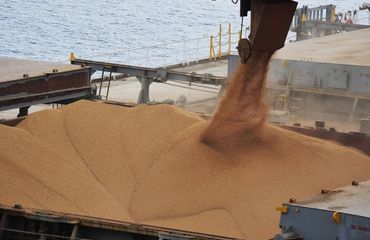
São Paulo – Brazil’s upcoming soybean crop is expected to yield 92.4 million tonnes in 2015, up 7.3% from this year. Exports should be up 4.3% to 62.5 million tonnes. In a press release issued this Monday (3rd), the Brazilian Ministry of Agriculture, Livestock and Supply asserts that the Crop Transportation Management workgroup is mapping out the product’s primary export routes.
According to the ministry, output and shipping are set to increase because the weather will favour soy farming and the commodity’s prices are dropping.
The Port of Santos should be the premier export outlet. Year-to-date through September 2014, 12.7 million tonnes were shipped out at the facility. The ports of Rio Grande, in the state of Rio Grande do Sul, Paranaguá, in Paraná, São Francisco do Sul, in Santa Catarina, and Vitória, in Espírito Santo, top off the list of five leading soybean shipping points.
As per the press release, from next year onwards, six ports in North and Northeast Brazil which comprise the so-called Arco Norte (North Arch) have the capacity to ship larger amounts of soybean, pressure from facilities in the South and Southeast.
According to the ministry, the ports of Itacoatiara, in the state of Amazonas; Salvador and Ilhéus, in Bahia, Vila do Conde and Santarém, in Pará; and Itaqui, in Maranhão, will see a combined 6 million-tonne increase in export capacity, which should help offload production, because they are nearer the crop areas than those in the Southeast. The bulk of Brazilian soybean originates from the country’s Midwest.
Year-to-date through September this year, these ports shipped a combined 8.2 million tonnes of soybean, according to ministry figures. In the comparable period of 2013, 6.7 million tonnes were shipped. The ministry’s workgroup convened last Thursday (30th) and is implementing measures to minimize logistics bottlenecks in soy transportation and shipping, such as the accumulation of trucks waiting on highways for the product to be loaded onto ships. In March 2013, a Chinese customer even cancelled a purchase of Brazilian soybean due to delayed shipping.
According to the ministry’s press release, members of the Crop Transportation Management workgroup are visiting ports in North Brazil to determine each facility’s throughput capacity, before meeting again in December to look into other measures.
*Translated by Gabriel Pomerancblum

