



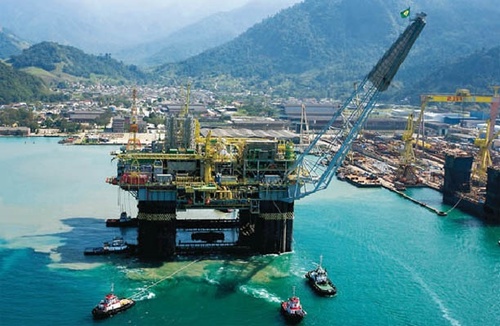
Rio de Janeiro – The consortium formed by Shell, Total, CNPC, CNOOC and Petrobras was the winner of the 1st Brazilian Pre-Salt Round and will have the right to explore and produce oil in Libra area, in Santos Basin. Of the 70% won by the consortium, 20% belongs to Shell and 20% to Total. CNPC and CNOOC each have 10%, as does Petrobras, which already had a mandatory 30% share. The auction took place in Rio de Janeiro.
Libra has estimated reserves of between 8 billion and 12 billion barrels of oil, not yet confirmed. In case the potential is confirmed, Libra will be the largest oil field in the country. ANP estimates that, at its production peak, daily extraction should reach 1.4 million barrels of oil, around two thirds of Brazil’s current total production (2 million barrels a day). The winning consortium was the only one bidding.
Exploration of oil in the shared system guarantees the national interests, say specialists who closely followed the Libra Field auction, the first of the pre-salt layer, promoted at a hotel in Barra da Tijuca. Despite the several protests against the auction, specialists believe that the shared regime is more advantageous to the country than the concession system, adopted before.
To the Economic Development secretary of Rio de Janeiro, Júlio Bueno, the auction should start a new phase of progress for the country, and specially for the states of the Southeast. The president of the Brazilian Oil, Gas and Biofuel Institute (IBP), João Carlos de Luca, pointed out the Brazilian interest is guaranteed with the new system.
"The share system guarantees the national interests, even due to the fact that there is a greater government take than in the concession system. And the government understands that, owning the oil, it has access to the wealth. It is a matter of discussing whether sharing is better than concessions. But royalties are 15%, a greater value than granted in concessions, and the government keeps a share of the oil profit. So the country’s interests are surely guaranteed,” pointed out Luca.
*Translated by Mark Ament

