



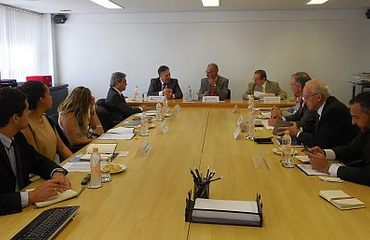
São Paulo – The Brazilian members of the Brazil-Tunisia Business Council convened this Tuesday (02) at the Arab Brazilian Chamber of Commerce in São Paulo to discuss actions for this year. One of the proposals that were presented and approved by the participants is the establishment of a workgroup tasked with removing eventual hurdles to bilateral trade.
“The obstacles must be addressed,” said the Tunisian ambassador in Brasília, Sabri Bachtobji, who attended the meeting. “Governmental institutions must be made aware of the obstacles preventing economic players from furthering their business,” he added.
Some of these bottlenecks were mentioned during the meeting. The director for Poultry at the Brazilian Animal Protein Association (ABPA), Ricardo Santin, for instance, remarked that Tunisia requires certificates no other country does, and this renders poultry exports from Brazil to the Arab country unfeasible.
The president of fertilizer conglomerate Intertrade Group, Heinz Huyer, noted that Brazil is struggling with phosphate importation from Tunisia for the last few years due to supply and logistics issues, whereas it used to be a major buyer.
Also mentioned were agreements currently under discussion by diplomats that, once approved, could propel bilateral trade and mutual investment. One is a framework agreement to enable talks to begin on a free-trade treaty involving Tunisia and the Mercosur.
According to the ambassador, a draft has been ratified by the Tunisian Parliament, but the South American bloc countries have yet to do the same. Bachtobji believes approval from Brazil could unlock the proceedings, considering the country’s economic and political clout within the group.
Another agreement being discussed – this time a bilateral one – pertains to investment facilitation and promotion.
Arab Chamber Foreign Trade vice president and meeting host Rubens Hannun said the council has medium- and long-term goals, and the workgroup is one of the mechanisms that could help enlarge trade and investment flows.
By identifying private sector needs and offering solutions, the council could work in tandem with governments to eliminate hurdles. “That way things can move forward in a simpler, faster way,” Hannun asserted.
Visit
A few bilateral agreements will be signed during a visit of the Brazilian Foreign Minister Mauro Vieira to Tunisia, scheduled for March 11. According to Bachtobji, those will be cooperation deals in tourism, social programs and the planting of eucalyptuses.
The ambassador said tourism, for instance, is a key activity for Tunisia’s economy, but the number of Brazilians who travel to the Arab nation and the other way around is not growing as it might. He added that the tourism agreement encourages tour operators to work on increasing tourist numbers.
Apart from the workgroup and the minister’s trip, the council members also discussed holding the annual meeting with their Tunisian counterparts. The idea of having the event in parallel with the upcoming Tunisia Investment Forum, slated for June or September in Tunis, was met with approval.
Walker Lahmann, the CEO of pharma company Eurofarma, attended the forum in 2015 and praised the event. His enterprise has plans of establishing a unit in Africa, and Tunisia is seen as a good option. According to him, despite being smaller in size, the Tunisian market resembles Brazil’s, with similar regulatory requirements, and the council’s workgroup could help smooth off any rough edges.
For her part, the International Relations manager of the Brazilian Electrical and Electronic Industry Association (Abinee), Fernanda Garavello Gonçalves, announced that the organization is discussing a trade promotion program with the Brazilian Export and Investment Promotion Agency (Apex-Brasil) and that several industry players are interested in the region.
“North African countries are drawing lots of interest from companies,” Gonçalves said. Most business owners, she said, are betting there’ll be demand from the energy industry.
The Brazil-Tunisia Business Council was established in 2002, but did not meet for several years until it was reactivated last year and new members were appointed.. Hannun, who presides over the body on the Brazilian side, was pleased with the meeting’s dynamics and remarked that the group displayed cohesiveness regarding the actions to be taken.
Also attending the meeting were the vice president of the Federation of Industry of the State of São Paulo (Fiesp), Elias Haddad, and ambassador Ramez Goussous, the Arab Chamber’s senior advisor for Institutional and International Relations.
*Translated by Gabriel Pomerancblum

