


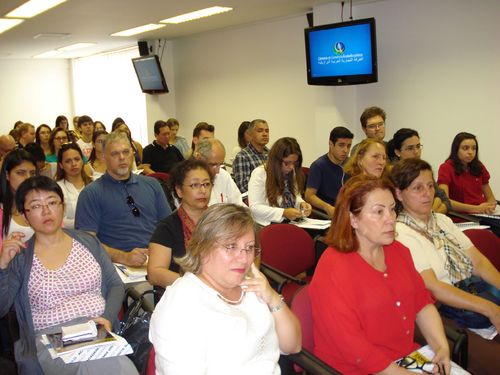
São Paulo – São Paulo hotel and tourism industry representatives underwent training on Arab culture this Thursday (12th) at the Arab Brazilian Chamber of Commerce. In order to prepare the tourism industry in São Paulo to receive foreigners, especially for the 2014 FIFA World Cup, the São Paulo Convention & Visitors Bureau is promoting actions of this type. This week, it was time to talk about the Arabs.
Approximately 50 people, including hotel industry professionals, tourism students, and interested parties convened at the Arab Brazilian Chamber headquarters and heard tips from the organization’s CEO, Michel Alaby, and Business and Markets manager Rafael Abdulmassih, and asked questions regarding the behaviour of Arab tourists. “Arabs are hospitable, attentive, they value family and religion,” the CEO told those in attendance.
To start off, Alaby gave a basic explanation of who are the Arabs, a people defined by their language, ethnicity, and for integrating the Arab League, and on who are the Muslims, i.e. the followers of Islamic religion, notwithstanding whether they are Arab or otherwise. The CEO mentioned countries which are not Arab, but are Islamic, or those in which a large portion of the population is Muslim, like Indonesia, Iran and India.
The attendees were given a few tips by Alaby on how to chaperone Arabs and Muslims at hotels, including separating the bacon and the ham from the other breakfast items, because Muslims do not eat pork and its products; removing all alcoholic beverage from Arab guests’ minibars; and signalling in the room, using a compass, the direction of Mecca, i.e. the direction at which the sun rises, because Muslims pray with their head bowed in that direction five times a day.
Abdulmassih showed the geographic placement of the Arab countries to those in attendance and listed the best languages in which to communicate with people from each of them: in French with people from the Maghreb countries, like Mauritania, Morocco, Tunisia and Algeria, and in English with people from the other Arab countries. The manager suggested the Arabs’ preferred conversation topics, like soccer, Arab influence in the world, the history of the Arab world, business. “They are fans of Brazilian soccer,” he said.
He also set forth a few rules for business transactions with Arabs, like the notion of time, which is a bit more lenient and different from the West, with longer meetings, a few interruptions regarded as usual, a greater observance of hierarchy and respect elders, among other premises. “The Arabs deal with people, not organizations. Upon leaving a company, introduce your successor to Arab contacts first,” said Abdulmassih.
The participants were keenly interested in learning how to receive Arab visitors, from the compliments to be paid to day-to-day demeanor. Other topics were tackled, including an exposé on the reasons for halal food consumption, the facilitation of contacts brought about new air routes between Brazil and Arab countries, the tourist spots in São Paulo that relate to Arab and Islamic culture, and where Arab visitors can be taken.
The meeting was conducted by the market relations manager of the São Paulo Convention & Visitors Bureau, Sara Souza. The bureau is a non-profit organization that seeks to increase business volume and consumption in the city, through tourist activity, supporting the improvement of services provided to visitors.
*Translated by Gabriel Pomerancblum
