



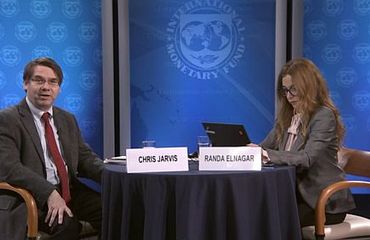
São Paulo – The International Monetary Fund (IMF) made public this week positive assessments on the implementation of economic reforms in Egypt and Saudi Arabia. In a press conference this Tuesday (17), the head of the Fund’s mission in Egypt, Chris Jarvis, listed a series of measures that are being adopted by the country in keeping with the agreement signed with the financial institutions for the approval of a USD 12 billion loan.
According to Jarvis, Egypt had been facing three major macroeconomic problems: one with external accounts, with the reduction of foreign currency flows, low reserve levels and balance of payments deficit; another in the domestic scenario, with high fiscal deficit and raising debt; and also an extended period of weak growth, resulting in an unemployment level of 12.7%.
Then, the government started to adopt a series of reforms and, last November, announced a more flexible exchange rate policy – up to then a more controlled one –, which caused the devaluation of the Egyptian pound and the increase of dollar inflow to the country. Also last November, the IMF approved the first installment of USD 2.75 billion of the loan. The second one could come as early as the first half of 2017.
To Jarvis, the devaluation of the Egyptian pound will encourage exports and, consequently, create jobs within exporting sectors.
The Egyptian package, according to Jarvis, includes the creation of a value-added tax (VAT) – already approved by Congress – fuel subsidies cuts, control of public sector’s wages and, to partly mitigate the weight of the adjustment, an increase in spending with social programs to 1% of the Gross Domestic Product (GDP). The implementation of these reforms, in his view, had a good start. “The government is doing what it said it would do,” he pointed out.
There are also initiatives to facilitate the issuance of industrial permits, reform bankruptcy legislation and promote greater inclusion of women in the labor market. “And this raises the prospects of really improving the living standards in Egypt over the next three years,” said the executive. As examples of countries that went through similar, but not identical, processes, he mentioned Brazil and Turkey.
Saudi Arabia
In the case of Saudi Arabia, also this Tuesday, the head of the IMF’s mission to the country, Tim Callen, detailed, in a press conference, the data presented in the last update to the Fund’s World Economic Outlook, launched on Monday.
He said that despite the Fund revising down the forecast for Saudi growth for this year from 2% to 0.4%, this was basically due to the country’s decision to cut its oil output, according to agreement signed by members of the Organization of the Petroleum Exporting Countries (OPEC), but that a recovery of growth of non-oil sectors should take place. The growth forecast for the non-oil economy in 2017 is 2%, lower of what has been in the past, but higher than the one registered in 2016.
Callen pointed out that there’s been a recovery in confidence by investors of the Saudi economy after the recent launching of public debt bonds and the payments of late debts by the government. “Saudi debt will remain attractive even if the debt ration goes up to 30% of GDP. That is still low by international standards,” said the executive, adding that the country and its state-owned funds have substantial assets.
He expects a degree of easing of the fiscal policy this year in comparison to the last two, which should help drive up the non-oil sectors.
The executive added that Saudi Arabia increased greatly the transparency of its fiscal policy, loosened bank rules to ensure greater liquidity and announced reforms in the capital market. The Saudis recently launched a reform program called Vision 2030.
The country, according to Callen, plans to reign in the fiscal deficit until 2020 via cuts of expenditures, increase of non-oil revenues and the adoption also of a value-added tax (VAT). Saudi revenues come mainly from exports of oil and its products, and the lowering of the commodity’s prices in the last few years caused the state’s revenues to go down. The deficit this year is expected to be below 10% of the GDP.
Many Saudis work in the public sector and one of the country’s challenges, according to him, is to create jobs for locals in the private sector, encourage entrepreneurship among the local population and increase participation of women in the labor market. To do so, Saudis need to invest in education and training to provide a skilled workforce to the private sector. The unemployment rate stands near 12%.
*Translated by Sérgio Kakitani

