



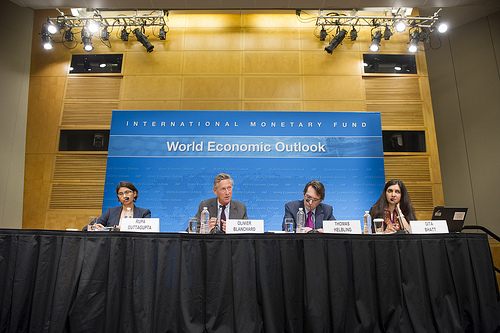
São Paulo – The International Monetary Fund (IMF) has revised down its economic growth projections for the Middle East and North Africa for this year and the next. According to the latest update of the World Economic Outlook report, released last Tuesday (9th) in Washington, DC, the IMF estimates that the region’s Gross Domestic Product (GDP) will be up 3% in 2013 and 3.7% in 2014. Both forecasts have been revised down by 0.1 percentage point from April’s estimates.
“Growth in some economies in the Middle East and North Africa remains weak because of difficult political and economic transitions,” according to the Fund’s update, which makes mention of the developments of the so-called Arab Spring, in 2011.
The revision, however, was slight compared with the global average. Global economic growth projections have been reduced to 3.1% this year and 3.8% in 2014, down 0.2 percentage point from April’s figures. The GDPs of emerging and developing countries are expected to be up 5% this year and 5.4% next year. Both are down 0.3 percentage point from April.
In an online press conference, IMF chief economist Olivier Blanchard said new hazards to global economic growth have added to the critical scenario in Europe, including the perspective of more modest growth in China, the doubtful sustainability of Japan’s GDP growth, and the fact that the United States’ quantitative easing policy is expected to end.
These factors exert downward pressure on international demand and commodities prices, directly affecting emerging economies. Furthermore, according to the Fund, domestic issues such as infrastructural bottlenecks prevent some developing countries from achieving greater growth. To the Fund, emerging countries will keep growing at higher rates than developed ones, though at a lower rate than in the past.
Such is the case with Brazil. The country’s GDP growth projections have been lowered to 2.5% in 2013 and 3.2% in 2014, down 0.5 and 0.8 percentage point, respectively, from April. According to Blanchard, Brazil has a low investment-to-GDP ratio. The IMF’s Global Economic Studies Division chief Thomas Helbling added that after a decade of fast-paced growth fuelled mostly by rising demand, Brazil is now stumbling on its limitations, namely poor infrastructure and a lack of qualified labour.
Meanwhile, inflation is high and Helbling believes it would be a mistake to implement new monetary stimuli in a bid to boost consumption. What Brazil needs to do, analysts have said for quite some time now, is to foster growth on the supply side, i.e. the investment side.
It is the opposite of what is taking place in China, where for years the government has encouraged growth via investment, and now needs to drive consumption up. For the sake of illustration, the rate of investment in China’s productive sector is around 45% of the GDP, while in Brazil it amounts to less than 20%.
In that respect, Brazil and the emerging countries are faced with yet another issue, which is the expected ending to the United States’ quantitative easing policy, which consists of the Fed’s purchasing government bonds from financial institutions, so as to put more money into circulation.
Once the policy is over, investors who withdrew their funds from the US to put them into emerging countries seeking higher earnings may now take the reverse route. “The end of quantitative easing will cause US government bonds to become more attractive, and investors who had fled to emerging countries may want to repatriate their funds,” said Blanchard. He noted, however, that some, not all of the money which was moved into developing markets should return to the US.
*Translated by Gabriel Pomerancblum

