



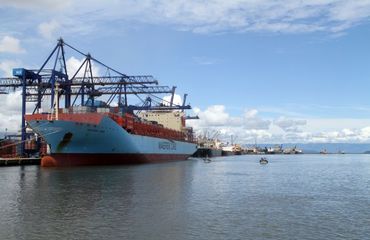
São Paulo – Brazilian trade balance recorded a deficit in the third week of January and increased the month’s negative results. According to results from January 12th to 18th, released this Monday (19) by the Ministry of Development, Industry and Foreign Trade (MDIC, in the Portuguese acronym), Brazil exported the equivalent of US$ 3.661 billion and imported US$ 4.140 billion, which resulted in a deficit of US$ 479 million. In the 11 business days until last week, the balance was US$ 1.462 billion negative. Until the second week, the deficit was of US$ 983 million.
January’s cumulative exports stand at US$ 7.515 billion, that is, a daily average of US$ 683.2 million, according to data from the MDIC. This result represents a 6.2% drop over January 2014.
External sales of commodities went up 4% and were driven to this by crude oil, wheat in grain, kaolin and other clays, soybean, coffee, raw cotton, tobacco, rice and pepper. Between semi-manufactured products, the growth stood at 8.5%, with expansion coming, mainly, from sales of raw dendê oil, cast iron, synthetic rubber and factice, ferro-alloy, raw sugar and sawn timber.
But the exports of manufactured goods dropped 23.3%. There was a decrease in sales of aircraft, autos, flat-rolled products of iron and steel, fuel oil, electrical engines and generators, hydrocarbons and derivatives, paper and paperboard for writing and printing, malleable cast iron tubes, auto parts and auto engines and their parts.
In the same period, Brazil imported the equivalent of US$ 8.977 billion, with a daily average of US$ 816.1 million. This result represents a drop of 10.6% over January 2014. The biggest expenses were recorded with the purchases of fuels and lubricants, but with a drop of 36.5% over January 2014 average; cereals (drop of 30.4%), autos and auto parts (- 20.9%), mechanical equipment (- 17.8%), rubber and rubber products (- 14.8%) and electrical and electronic equipment (- 12.7%).
According to the MDIC, in last year’s January, the trade balance was US$ 4.068 billion negative. In December 2014, the result was positive by US$ 293 million.
*Translated by Sérgio Kakitani

