


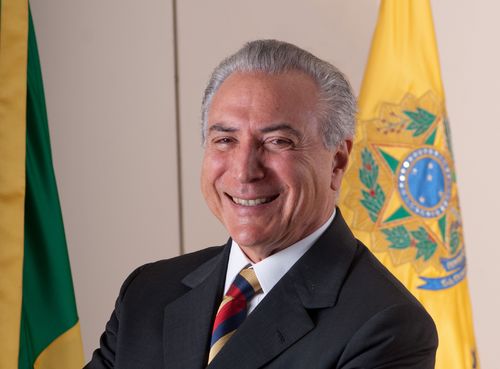
São Paulo – Brazil’s vice president, Michel Temer, will be celebrated by the Arab Brazilian Chamber of Commerce on Monday evening (25), the National Day of the Arab Community, in the city of São Paulo. Temer has Lebanese roots and was appointed by president Dilma Rousseff to take care of relations between Brazil and the Arab world. As part of this mission, he has already travelled to Lebanon, has a trip scheduled to Oman, where he will have meetings to foster business, and is focussing on a request by Lebanese president Michel Sleiman, who asked for closer ties between Petrobras and his country, for exploration of gas in the Mediterranean.
In an exclusive interview to ANBA, Temer stated that he feels greatly honoured in being celebrated by the Chamber as the organisation pays homage to people who provide services to the community. “This is a very special reason for me to feel proud of this celebration,” he said, mentioning the names of those celebrated by the organisation previously, namely former president Luiz Inácio Lula da Silva, when in office, Violeta Basílio Jafet, the honorary president of the Syrian-Lebanese Hospital, cardiologist Adib Jatene and Gilberto Kassab, the former mayor of São Paulo, also when in office. At that date, the Chamber also celebrated professor Helmi Nasr, the International Relations vice president at the organisation.
Temer’s parents arrived in Brazil, from Btaaboura, a village in Lebanon, in the 1920s. Three of the vice president’s brothers were born in the country. He is the youngest, the last of eight offspring. Temer says he still has a clear memory of what his parents transferred to him about Lebanon. He only travelled to the country in his adult life, but he has relatives there and maintains these ties. “I have already been to Lebanon twice and at those occasions I visited my parents’ village, a little village in El Khoura, in the hills, and was celebrated by relatives and by the inhabitants of the city, the Lebanese people,” he said.
Temer stated that he feels connected to Arab culture and explains the customs of the region that are part of his daily life. “At my house, Saturdays and Sundays were Arab food days,” he said. The vice president does not speak Arabic, but can at least understand the theme of the conversation when two people are speaking the language. “I heard it throughout my childhood,” he said, regarding the mother tongue of his parents. Temer also said that he likes the music of the region and continues informed about events there.
As the vice president of the Republic, the son of Lebanese found another reason to come closer to the Arabs: bringing Brazil politically and economically closer to the region. Temer was in Lebanon in 2011, when he met Sleiman, and had a meeting on Brazilian navy frigate União, which had just joined the United Nations (UN) peace forces in the region. “I am much focussed on a request made to me by Lebanese president Michel Sleiman, to establish a partnership between Lebanon, Lebanese companies and Petrobras, as they want to explore gas there, in Lebanese territorial waters,” said the vice president.
Temer also visited Doha, Qatar, in November 2011, where he participated in the 4th United Nations Alliance of the Civilizations Forum. He says he feels impelled to increase relations between Brazil and the Arab countries and, apart from talks with Arab authorities in these countries, he has also been meetings with authorities from the region when they visit Brazil. The trip to Oman, on April 1 and 2, progresses in that direction. Temer should be the first Brazilian authority (president or vice) to visit the Arab nation.
“The Ministry of Foreign Relations, Itamaraty, was working for my trip to Oman, where there is Brazilian investment, starting with Vale,” said Temer. The Brazilian mining company has a pelleting plant and a port terminal in the country, and they will be visited by the vice president. Temer should travel in the company of a group of 15 representatives of Brazilian companies interested in investing in Oman. He should have meetings with local authorities, including Sultan Qaboos Bin Said Al-Said. The delegation will include meetings with Omani businessmen and authorities in the Arab country.
The ceremony in honour of Temer will take place at the Syrian Sports Club, at a dinner, and should include the presence of Brazilian businessmen with business in the Arab world and leaders in the area of politics and culture who have relations with the region. "Over the past few years, on the Day of the Arab Community, the Arab Brazilian Chamber has paid tribute to prominent figures whose careers in the private sector, charity, or politics, have dignified our community and helped strengthen the ties of friendship between Brazil and the Arab countries," said Chamber president Marcelo Sallum. "In addition to his outstanding political career, Brazil’s vice president dr. Michel Temer is regarded as one of the foremost constitutional attorneys in the country, and played a key role in the last National Constituent Assembly," he said.
Sallum also said that since he took office as vice president of Brazil, Temer "has carried out missions designed to establish closer ties between Brazil and the Arab countries. In 2011, he paid an official visit to Lebanon and led Brazil’s delegation to the 4th Alliance of Civilizations Annual Forum in Doha, Qatar. In 2012, he promoted several meetings with Arab authorities in Brazil, and next month he is due to pay an official visit to the Sultanate of Oman."
The Arab Brazilian Chamber CEO Michel Alaby noted that “Temer is a natural politician, a personality in the community who contributed much to the economic and political development of Brazil. He has already visited several Arab countries, including Lebanon, and supports the development of relations between Brazil and the Arab nations.”
Born in Tietê, in the interior of the state of São Paulo, Temer graduated in Law from the University of São Paulo (USP). He then got his doctorate and lectured at the Pontifical Catholic University of São Paulo (PUC-SP). He started his career as the São Paulo State Safety Secretary, in the 1980s. As a congressman, he was the chairman of the Lower House on two occasions.
*Translated by Mark Ament
