



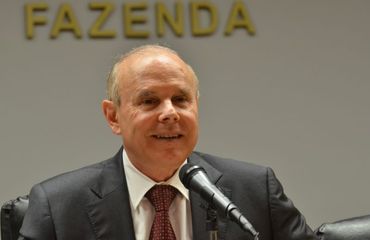
São Paulo – Finance minister, Guido Mantega, said this Friday (30th), in Brasília, that Brazilian Gross Domestic Product (GDP) grew only 0.2% in Q1, when compared to Q4 2013, due to exchange rate volatility, low expansion of the main economies, inflation and scarce credit. In the minister’s evaluation, these factors prevented Brazilian economy from having a larger growth from January to March.
The economy’s result for the period released this Friday by the Brazilian Institute of Geography and Statistics (IBGE) showed the agriculture’s GDP grew 3.6%, services’ increased by 0.4% and industry’s dropped by 0.8%. Brazil’s GDP in Q4 2013 grew 0.4% over Q3.
“Although total wages grew and number of employees and wages have been increasing; credit is scarcer and inflation, mainly for foodstuff, decreased family’s consumption,” said the minister, according to Agência Brasil.
Mantega said the government is controlling inflation and that prices may rise for one or two months due to “seasonal factors”, such as the increase in food price. He said drought in the beginning of the year prevented crops from having a better development, mainly in maize production.
The minister, however, ensured that inflation in Q2 will be much smaller than in Q1. In March, the twelve-month period inflation reached 6.15%. The inflation target of the Brazilian Central Bank is 4.5% per year, with a 2% tolerance range, up or down.
Exchange and current circumstances
Mantega said that exchange rate oscillation was another reason why Brazilian GDP dropped. “Throughout the quarter, it has improved, but it has affected the results of the first two months,” he said, stating that foreign volatility should be smaller in the next few months, which will bring “stability” to the markets.
The minister ascribed the shy results of Brazilian GDP to foreign countries’ results. “In the US we could see a decline of 1% in the growth, with a drop in investments and the demand not growing. This affects us because the US imports less. Even Europe had a growth below projections,” he said.
According to data from the IBGE, family’s consumption had a decline of 0.1% in Q1 2014 in comparison to Q4 2013. Government expenditure increased 0.7% and investments dropped by 2.1%.
*Translated by Rodrigo Mendonça

