



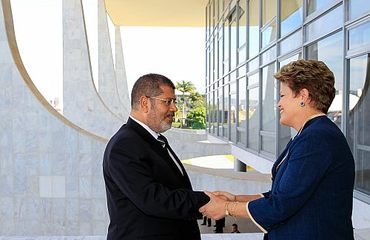
Brasília – This Wednesday (8th) in Brasília, following a meeting with the Brazilian president Dilma Rousseff, Egypt’s Mohamed Morsi said his country wants to boost trade and attract investment from Brazil. “Bilateral trade needs to increase,” he said. “We need more Brazilian investment in Egypt,” he added.
Fostering trade relations between the two countries is one of the purposes of Morsi’s visit to Brazil. On Thursday (9th) he will attend meetings with businessmen at the Federation of Industries of the State of São Paulo (Fiesp).
Rousseff, in turn, said this is the first-ever visit of an Egyptian head of state to Brazil. She said the country is the leading destination of Brazilian exports to Africa. “We must increase (trade) and make it more balanced,” she said, referring to the fact that Brazil runs a strong surplus in trade with Egypt.
The Brazilian president said the free trade agreement signed by Egypt and the Mercosur “will open up new vistas for increasingly diverse exchanges.” The treaty, however, has not yet been endorsed by the parliaments of the South American bloc’s member countries.
Rousseff also said that during her meeting with Morsi it was decided that a Brazilian mission will go to Egypt this year. On the other hand, a delegation of Egyptian businessmen is travelling alongside the president.
Brazil’s Development, Industry and Foreign Trade minister Fernando Pimentel, who attended the meeting, noted that Egyptians “want more Brazilian enterprises in their country” and that they have “expressed great interest in doing business with Brazil.” “The outlook is very good,” he said.
Agreements
Another highlight of the visit was the signing of cooperation treaties. The two governments have entered into agreements for agriculture, agrarian development, social development, environmental policies, between Brazil’s National Library and The Library of Alexandria, and for technical cooperation.
Rousseff said the Egyptian government wants to strengthen agricultural production in the country, hence the agricultural and agrarian development agreements, which include biofuel production development. “Brazil’s experience [in this sector] is at their disposal,” she said.
She also said there is “strong potential for cooperation” in the defence, civil and military aviation industries. Embraer had an assembly line for its Tucano military aircraft in Egypt in the past, and it has also sold business jets to EgyptAir in the last few years.
“We can put Brazil’s experiences to use in our region,” said Morsi regarding the deals signed and other potential areas for cooperation. “Brazil can be immensely helpful to Egypt’s development and the implementation of social justice,” she added. Brazil’s social programs are of particular interest to Egyptians, and this Wednesday afternoon Morsi watched a presentation on Brazilian social development programmes following luncheon at the Foreign Ministry (Itamaraty).
He added that Egypt is also interested in Brazil’s experience with transitioning from dictatorship into a democracy. Morsi was the first president-elect in Egypt after Hosni Mubarak’s 30-year rule, which came to an end as he stepped down amidst the Arab Spring. Brazil was ruled by a military dictatorship from 1964 to 1985, after which the power returned to civilians.
Multipolarity
The two presidents also discussed multilateralism, in particular South-south cooperation. Rousseff mentioned the summits of South American-Arab Countries and South America-Africa, of which both countries are members, and which “deserve our attention,” and spoke of tandem work at international forums. “We need to develop our relations within the scope of the Brics and other forums,” said the Brazilian head of state.
Morsi said recently that he would like for Egypt to eventually become a part of the bloc composed of Brazil, Russia, India, China and South Africa, thus establishing the E-Brics.
Rousseff also spoke for reforms at the United Nations, especially the Security Council, leading to greater participation of developing countries, including Arab and African countries, and at the International Monetary Fund (IMF), to make further room for emerging economies. Egypt is negotiating a US$ 4.8 billion loan with the IMF.
“South-South cooperation among our countries is strategic to establishing multipolarity,” said Rousseff. She also gave thanks for Egypt’s support to the election of Brazil’s Roberto Azevêdo for director-general of the World Trade Organization (WTO).
Also regarding international politics, Morsi praised Brazil’s backing of the Palestinian cause, and other areas of interest to Arabs. “This means a lot to us, we greatly respect Brazil for that,” he said.
The two presidents called for the independence of Palestine and an end to the Syrian civil conflict through a negotiation spearheaded by the Syrians themselves, with support from other Middle Eastern countries and the international community. “As long as these issues remain unsolved, there will be no stability in the region,” said Morsi.
During luncheon at the Itamaraty, Rousseff proposed a toast to celebrate the “new agenda for cooperation” between the two countries, but she used fruit juice, because Morsi is a Muslim and therefore does not drink alcohol.
Luncheon was attended by ministers, diplomats, politicians, businessmen, among other personalities. The president of the Arab Brazilian Chamber of Commerce, Marcelo Sallum, and the former president, Salim Taufic Schahin, were also in attendance.
This Tuesday, Morsi had meetings scheduled with the president of the Brazilian Congress, senator Renan Calheiros, and the former Brazilian president Luiz Inácio Lula da Silva.
*Translated by Gabriel Pomerancblum

