



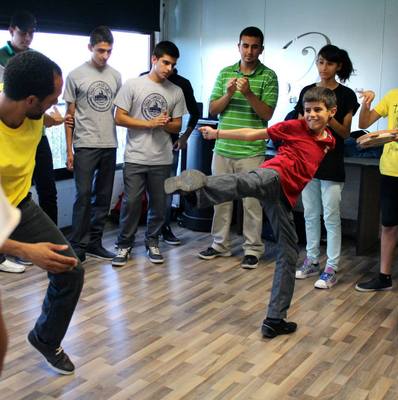
São Paulo – Passionate about capoeira, Tarek Alsaleh, a German of Syrian descent, who graduated in Sports Science, moved to Damascus in 2007. There, he started teaching the Brazilian martial art to children in the streets of the city. The interest of youths in the activity grew and the practice was also taken to prisons and hospitals. With the support of The United Nations Children’s Fund (Unicef), Alsaleh also started teaching the sport at refugee camp Al Tanf, on the frontier between Syria and Iraq. That was where ‘Bidna Capoeira’ (We Want Capoeira, in Arabic) was born, using a mixture of fighting and dancing to improve the life of young refugees.
Currently the project is in operation in Syria, the West Bank and Eastern Jerusalem, with participants from the age of 7 to 22 years of age. Apart from practicing capoeira, the students also learnt the history and culture of the sport. “The parallels that capoeira offers to youths in situations of vulnerability are extremely valuable to help them deal with the hardships they face,” said Ummul Choudhury, co-founder and director at the NGO.
She recalls that refugee camps are overcrowded, impoverished areas in which physical violence is part of the everyday life of youths. With few places to play in, she says, many children present behaviour problems, like aggressiveness, depression and hyperactivity.
“Bidna Capoeira uses an exclusive artistic form of capoeira that is not competitive in an attempt to break the cycle of violence and isolation and to improve psychosocial health of desperately vulnerable youths,” said Choudhury.
Some of the instructors are Brazilian, but the project also trains local instructors. “Our programme in Syria is managed by local people who started as our students and developed, to become instructors. We work on institutionalising the social value that capoeira can bring to youths who have been traumatized and are vulnerable and to be able to spread this message,” said the director.
From Brazil, other items brought include the songs sung while practicing. “Capoeira songs are taught in Portuguese, as is the meaning and the story of capoeira. We also work with our students to create songs in Arabic that are adapted from the original Portuguese,” said Choudhury.
The director also reveals that the NGO plans to expand its work. “We are going to start projects in Jordan in 2014. We hope to connect, inspire and access the global capoeira community through our projects,” she finished off.
The NGO’s current budget is 320,000 pounds sterling. According to Choudhury, the organisation counts on the help of the government of Brazil to develop projects.
Those interested in learning about Bidna Capoeira may visit site www.bidnacapoeira.org or the project’s page on Facebook www.facebook.com/BidnaCapoeira.
*Translated by Mark Ament

