



Copenhagen – A report issued by the Organization for Economic Development and Cooperation (OECD) this Thursday (21st) in Paris says Brazil shows promising signs when it comes to minimizing social inequality, as do Peru, Mexico, Argentina and Chile. Despite the good results, Latin America is still one of the regions in the world with the widest gap between the rich and the poor.
The report gives a specific overview of inequality in emerging economies, measuring their results against the median for its member countries. Brazil’s Gini coefficient – an income inequality index – is 0.56, not as high as the 0.60 score from the 1990s. The closest to 1 the rate is, the more unequal a country is, and the closest to 0, the less unequal. In spite of its improvement, Brazil is the most unequal of the OECD’s member states, whose average is 0.32.
Brazil is more unequal than its Latin American counterparts Chile, Argentina, Peru and Mexico. It has the second highest Gini coefficient of the Brics (Brazil, Russia, India, China and South Africa), trailing South Africa (0.67).
The downward trend seen in Latin America and the Caribbean, the report says, contrasts with growing inequality across most OECD member countries, especially those that implemented fiscal austerity measures in response to the economic crisis of 2008 and 2009. Presently, in the region assessed, the richest 10% of the population earn 9.6 times more than the poorest 10%. The ratio dropped from 7 to 1 in the 80s to 9 to 1 after the year 2000.
To OECD secretary general Angel Gurría, high inequality hampers growth. “The consequences are both economic and social,” he said. The report says income disparity is highest in Chile, Mexico, Turkey, United States and Israel and lowest in Denmark, Slovenia, Slovakia and Norway.
The study says emerging economies like Brazil were right to go the route of increased social protection measures and income redistribution in a bid to fight poverty and inequality.
Broadened access to education and higher minimum wages in Brazil and other countries have reduced income inequality at work. The wage difference between positions requiring higher and lower education levels has become narrower. The broader reach of cash transfer programs like Bolsa Família, for instance, has helped redistribute income and therefore spur development.
To shorten the gap between rich and poor and fuel growth, the report recommends measures to foster equality between men and women, increasing access to better jobs and investment in education and training, and income transfer-based redistribution of wealth. It also advises emerging economies to take measures toward formal labor and simpler tax systems. Brazil’s Simples Nacional system is cited as a successful example.
Adjustment
In Rio de Janeiro, the managing director of the International Monetary Fund (IMF), Christine Lagarde, championed fiscal discipline as a supporting tool for social programs in Brazil. This Thursday, she visited the Teleférico do Alemão lift, in northern Rio, alongside the minister of Social Development and Hunger Combat, Tereza Campello.
"Fiscal discipline is the foundation required for funding the programs. These two things are interdependent. Fiscal indiscipline affects the poorest people the most,” she said.
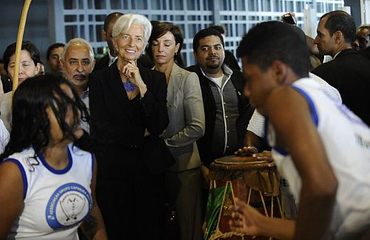
She embarked on one of the lift’s gondolas and watched a capoeira presentation at Estação Alemão station. On discussing Brazilian social programs, Christine Lagarde lauded the funneling of funds into Bolsa Família. “This is a historical fact,” she said.
After speaking with the IMF managing director, Tereza Campello said Lagarde praised the fact that the country benefits 50 million people by spending 0.5% of its Gross Domestic Product (GDP) on Bolsa Família. The minister also said Lagarde asked for details about Cadastro Único, a database of low-income families.
Tereza Campello told Lagarde that Brazil has developed “high technology” so social benefits could reach the poorest. “It is inexpensive and reaches those that it must, and isn’t incompatible with expenditure reduction efforts,” she said.
*Translated by Gabriel Pomerancblum

