



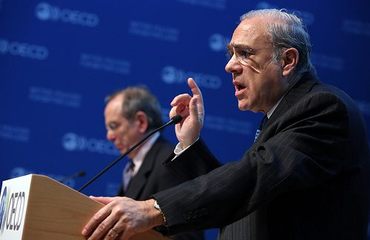
São Paulo – The Organization for Economic Cooperation and Development (OECD) has revised down its global economic growth estimates for 2013 and 2014. According to the six-monthly publication World Economic Outlook, released this Tuesday (19th), in Paris, he global Gross Domestic Product (GDP) should be up 2.7% in 2013 and 3.6% in 2014. In May, when the last edition of the report was issued, the forecasts were 3.1% and 4%, respectively. In 2015, the organization believes the world economy will grow by 3.9%.
According to an OECD press statement, the downward revision is due to a worsening of perspectives n some emerging economies. A case in point is Brazil. By May, the OECD forecasted that the country would grow by 2.9% this year and 3.5% next year. Now, the forecasts are 2,5% and 2.2%, respectively. The projection for 2015 is 2.5%.
To the OECD, growth has begun to pick up in China, but will be lower than expected in most of the other major emerging economies.
Despite the lowered estimates, the OECD secretary-general Angel Gurría has sadi that “the recovery [of the world economy] is real, but at a slow speed.” He warns, however, that “there may be turbulence on the horizon.”
“There is a risk of another bout of brinkmanship in the US, and there is also a risk that tapering of asset purchases by the US Federal Reserve could bring a renewed bout of instability,” said Gurría, referring to the internal political dispute in the United States, with recurring controversy regarding the raising of the country’s debt ceiling, and to the possibility of the Fed’s withdrawing economic stimulus.
“The exit from non-conventional monetary policy will be challenging, but so will action to prevent another flare-up in the euro area and to ensure that Japan’s growth prospects and fiscal targets are achieved,” the secretary-general added.
The OECD points out other worrisome situations: the slowing down of growth in global trade, in foreign direct investment flows, and in fixed asset investment; and a persistently high unemployment rate, especially in Europe.
With regard to the US, the OECD advises that the Fed should gradually wind down its asset purchases and quantitative easing – i.e. measures designed to inject dollars into the economy –, so as to limit impacts on vulnerable emerging markets. Whenever the Fed mentions the possibility of beginning to change its policy, the foreign exchange market goes berserk. Brazil was strongly affected by this phenomenon throughout this year, and the dollar has appreciated strongly against the Brazilian real.
The OECD also admonishes that the United States’ nominal debt ceiling should be abolished to prevent inner disputes in the US Congress local from placing the world economy at risk, as seen recently.
*Translated by Gabriel Pomerancblum

