



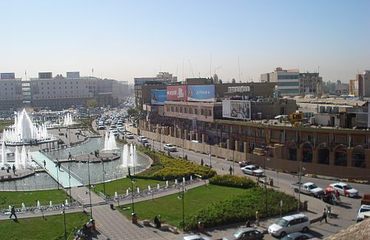
São Paulo – Eight Brazilian companies and organizations have confirmed their attendance to the Erbil International Fair, in Iraq, at the stand organized by the Arab Brazilian Chamber of Commerce and the Brazilian Export and Investment Promotion Agency (Apex). The 9th edition of the fair will be held from September 23 to 26 in the capital of the Iraqi Kurdistan region, in Northern Iraq.
The attending companies will be the meat packer Marfrig, the beef and commodity company West Food, marble and granite company Angramar, medical and hospital equipment companies Fanem and Magnamed, electric power network connectors manufacturer KRJ, the Federation of Muslim Associations in Brazil (Fambras), the Brazilian Association of Meat Exporting Companies (Abiec), and the Arab Brazilian Chamber.
According to the Brazilian ambassador to Baghdad, Anuar Nahes, due to its stability relative to other areas of the country and its economic development, the region “has become a gateway into Iraq.” “It is an autonomous region that is at peace, with ethnic and religious harmony,” the diplomat told ANBA. “It is a very prosperous area that is growing at full speed,” he said.
He added that Erbil grants access to markets other than Iraq’s, because Kurdistan as a whole includes Turkey, Syria and Iran. The Iraqi portion of the territory is currently taking in refugees from the Syrian civil conflict.
Nahes stressed that several international airlines offer direct flights to Erbil, which further cements the city’s business hub status. There are routes to Frankfurt, in Germany, Dubai, in the United Arab Emirates, Doha, in Qatar, Istanbul, in Turkey, among other destinations.
Beef
One of the fair’s sideline activities will be a barbecue hosted by Abiec for businessmen and local authorities. The goal is to raise the Iraqis’ awareness in order to authorize the importing of Brazilian beef, which has been banned since the Brazilian Ministry of Agriculture announced, last December, that the mad cow disease agent was detected in a cow in the state of Paraná, which died in 2010 without developing the condition.
According to the ambassador, the Iraqi National Health Committee should have a mission to Brazil soon, in order to meet with Brazilian authorities and pay visits to laboratories. It will be an opportunity for the Brazilian government and enterprises to demonstrate the sanitation conditions of its beef and the trustworthiness of its analysis procedures, because the Arab country possesses no laboratories technically able to conduct this type of verification, and thus ends up adhering to the measures adopted by other countries.
From the sanitation perspective, there is no reason for the embargo to continue, because last May, the World Assembly of Delegates of the World Organisation for Animal Health (OIE) confirmed a technical report from the OIE’s Scientific Commission which retained Brazil’s status as having “insignificant risk” for Bovine Spongiform Encephalopathy. It is the lowest risk level possible regarding the chance of occurrence of mad cow disease. To the OIE, the case seen in the state of Paraná posed no hazard to public and animal health in Brazil or its trade partner countries.
*Translated by Gabriel Pomerancblum

