



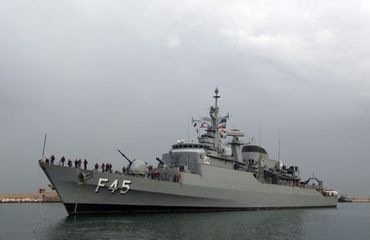
São Paulo – In 2006, the UN assembled the Maritime Task Force (MTF) as part of the United Nations Interim Force in Lebanon (UNIFIL) to secure peace in the country. Since 2011, the MTF is under the leadership of Brazil. To talk about the work of the task force in the Arab country, its commander, rear admiral Claudio Mello, from the Brazilian Navy, will be the speaker of the lecture UNIFIL Maritime Task-Force: Ten Years of Contribution to Peace and Stability in Lebanon. The event will take place this Thursday (28) at the Holy Spirit University of Kaslik (Usek) at the Lebanese city of Jounieh.
In an interview via email, Mello explained that the MTF has two main goals. One of them is to support the Lebanese government in stopping the illegal entry, by sea, of weapons and related equipment in its territories, and the other is to contribute in the training of the Lebanese Navy, to help it perform, on its own, the tasks related to maritime security in the water under its jurisdiction.
According to Mello, since its creation in 2006, fifteen countries already contributed to the MTF. “Until today, the MTF already interrogated more than 70,000 ships, redirecting near eight thousand of them to be inspected by Lebanese authorities. Thus, the presence of the ships of the Task-Force, patrolling continually the Lebanese coast, inhibits the illegal entry, by sea, of weapons that, otherwise, could be used for the instigation of violence or the perpetration of criminal or terrorist acts”, said the commander.
Besides the issues related to the security of the Arab country, Mello emphasized the work of the MTF in helping the Lebanese economy. “According to data from the World Bank and the United Nations Conference on Trade and Development [UNCTAD], while the Lebanese Gross Domestic Product [GDP] increased 108% between 2005 and 2013, which is significant, the maritime trade increase even more proportionally in the period at 127%”, he said.
To the rear admiral, “a more stable and secure maritime environment, brought by the presence of the MTF, contributes in the reduction of security and freight costs, to the increase in trade that flows through the Lebanese ports and, last, to the economic growth of the country as a whole”, he added.
The commander points out the Brazil took the leadership of the MTF in February of 2011 and that, since November of that year, started to send ships regularly to serve as captainship (the ship that is used by the general commander of naval operations).
“Besides the MTF contribution, under Brazilian leadership, to peace and stability in the region, with Brazil being a pacific country and the host of the largest population of Lebanese and Lebanese descendants outside Lebanon, our sailors have the trust and admiration of the Lebanese population, feelings that are reinforced, even more, by the organization of frequent civic-social actions with the local community”, said Mello.
He also brings up an episode in which the Brazilian Navy worked in the rescue of refugees. “The corvette Barroso, while crossing the Mediterranean, in September of 2015, to join the MTF-Unifil, rescued 220 refugees that were in a boat that was going under, answering the call of an Italian rescue center. Among those rescued, already debilitated for the time at sea, were women and children, some of them infants. The ship’s rapid reaction and the success in the rescue mission, when all of those aboard were saved, received extensive press coverage, Brazilian and international, contributing positively to the image of Brazil”, he said.
The lecture by commander Mello will be attended by students of Foreign Relations, Political Sciences and Law School at Usek. The event, which is open to the general public, was organized by the Latin American Studies and Cultures Center (Cecal) and by the Political Science Department of the university.
Lecture UNIFIL Maritime Task-Force: Ten Years of Contribution to Peace and Stability in Lebanon, with speaker rear admiral Claudio Mello.
April 28, 11 am
Where: Holy Spirit University of Kaslik (Usek), Jounieh, Lebanon, at the Jean El Hawa Auditorium.
*Translated by Sérgio Kakitani

