


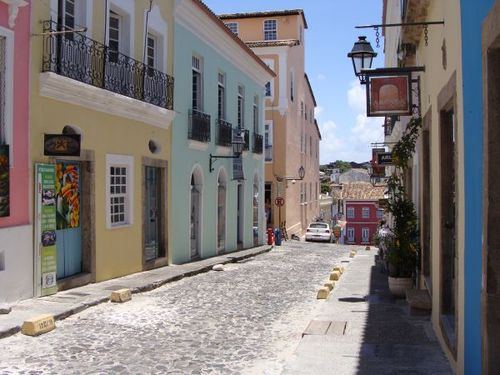
Salvador – The capital city of the state of Bahia has much to offer tourists: paradisiacal beaches, a handicraft market, the Model Market, delicious dishes, lively carnival and Barra lighthouse. And it also has the Pelourinho, part of the Historic Centre, famous for its colourful houses, but also boasting much history.
There, slaves were tortured in the colonial period (1500-1822), symbols of the wealth brought by the sugar cycle may be found, as, to this day, are some of the icons of African culture in Brazil. One of them is the unmistakeable sound of the drums of groups Olodum and Axé Brasil. Added to that is the typical attire of the “Bahianas”, worn in the candomblé yards, one of the religions brought to the country by African slaves.
A walk in the Pelourinho, also called “Pelô”, takes you among stone streets in which passenger cars are not allowed. Along this long route, visitors may view restored and colourful houses in colonial style. Each of them housing hostels, cultural centres and shops. These houses also include excellent restaurants and bars.
Before or after visiting the Pelourinho, tourists must take some time to try the most traditional delicacy of the cuisine of Bahia: acarajé, made out of bean paste and onions fried in palm oil, which may be found at several stands in the region. Some of them are at the gateway to the Historic Centre, at Terreiro de Jesus square.
A tourist dedicated to living the “climate” of the Pelourinho must also show his “faith” by tying a traditional Nosso Senhor do Bonfim bracelet around his wrist. Each knot grants the tier the right to make a wish, and each bracelet is tied to the wrist with three knots. Legend has it that, when the bracelet breaks, the wishes will be granted. But pay attention: the bracelet must be a present from someone. Those visiting the Pelourinho alone, however, need not fret, as many vendors in the region will spare no effort to present you with one of these bracelets (prior to trying to sell you some souvenir).
Sad stretch of history
The site is currently a cultural centre, bohemian, touristic and gastronomic, but it was not always such. During the period of slavery, that was where slaves were tortured. Pelourinho is the Portuguese term for pillory, where slaves and criminals were tied for chastising. And, in Salvador, the first Brazilian capital, until 1763, it was a place of suffering. Starting in the 17th century, the region started being occupied by mansions and beautiful churches that were the symbol of the wealth of landowners, resulting from the sugar cycle.
One of these constructions is the building that houses the church and convent of the Order of St. Francis, an example of the baroque style that formed the several other buildings in the region. The façade and interior of the church are full of ornaments in jacaranda wood, but none of that is compared to the main highlight of construction: the relief, columns and framework around the ceiling, which are gilded. Other churches in the region also show great wealth, as is the case with the Basilica Cathedral. But none other has as much gold as St. Francis.
Apart from acarajé, churches, shops history and colourful houses, Pelourinho also has another attraction, one that cannot be seen, touched or flavoured, but that can be heard. Truly heard! No matter what day of the week the tourists is visit the region, the soundtrack will be that of the drum beat of the blocks there, constantly either at practice or giving presentations. All of this has resulted in the region being recognized by the United Nations Educational, Scientific and Cultural Organization (Unesco) as a World Heritage site. Welcome. This is the Pelourinho.
*Translated by Mark Ament
