



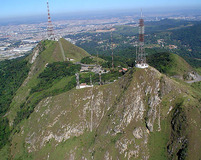
São Paulo – Those who come from other states or countries in the capital of São Paulo state don’t need to go into a popular restaurant or a sky-high hotel see the city from above. They only need to go to northwest São Paulo that to find, surrounded by a dense green area, the city’s highest point, Pico do Jaraguá, 1,135 meters high. “The Pico do Jaraguá and Pedra Grande, in Cantareira, are the two best views of the metro area”, said the executive director of Fundação Florestal, Luis Fernando Rocha.
Pedra Grande is an observation deck at Cantareira State Park and Fundação Florestal is the body of the Environment State Secretariat responsible for the state’s forests. The Pico do Jaraguá is a hill inside the Jaraguá State Park, one of the last with remnants of Atlantic Forest in São Paulo metro area. It’s 493 hectares, with 35 hectares for public use, that is, with open access to tourists and the public in general.
According to Rocha, the place receives around 500,000 people per year. Since there are no turnstiles or access control in the park, the Fundação Florestal doesn’t have specific data on the profile of visitors. However, the executive director of the organization says that the Jaraguá State Park receives as much residents of São Paulo as tourists from Brazil and abroad. The foreigners come especially from the United States of America and Latin America, according to Rocha.
One of the main attractions of the park is the view from the peak. On the top of the hill, there’s a concrete observation deck made accessible via a couple dozen stairs. There isn’t a tourist structure on top, only a couple of stools to take a breath before returning. The view is the great attraction. Down there, in the surroundings, it’s possible to see the dense forest of the park and, in the distance, the city with its buildings and houses and some of the main access highways to it.
In the park there are other attractions, such as children’s toys, a leisure area with barbecue facilities, exercise areas, a lake, and a water spring, among others. A lot of families from surrounding neighborhoods usually spend their Sundays in the park. In the denser forest areas it’s possible to spot animals, such as monkeys and several types of birds. There are four trails, the shortest with 20 minutes and the longest with two and a half hours. The park offers guides for the trails, but the service must be previously scheduled.
From the region surrounding the access to the hill comes a paved, sinuous and uphill road. It’s possible to go up by car until the access to the peak, but some residents turn the ascent – and the descent – as a chance to go trekking and bicycling. But the visitors need to walk by the roadside, which is narrow, and keep an eye on the cars going up or down. Up there, there isn’t an official parking lot so the parking spots around the road are much requested.
Snacks? There are only some for sale, such as ice cream or candy, and beverages such as water or sodas. If you’re going to spend several hours, it’s good to bring along a snack. The executive director of Fundação Florestal says that the agency is developing a plan to cover all parks and, based on it, actions and improvements will be defined.
The area of the Jaraguá State Park for public use is open every day for visitation, from 7 AM to 5 PM. The scheduling for the guides must be made at the park’s management center, from 8 AM to 5 PM, via phone at 55 11 3945-4532.
<b>Jaraguá State Park </b>
Estrada Turística do Jaraguá s/n
São Paulo – SP
Information: +55 11 3945-4532
Website: www.ambiente.sp.gov.br/parque-estadual-do-jaragua/
*Translated by Sérgio Kakitani
