



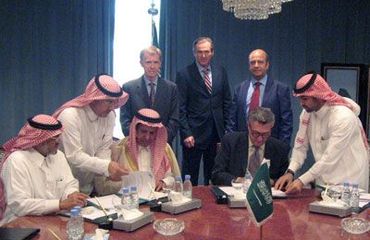
São Paulo – This Wednesday (29th), the Saudi Fund for Development (SFD) donated US$ 86 million to the United Nations Relief and Works Agency for Palestine Refugees in the Near East (Unrwa). The funds will be spent on projects in the West Bank, Gaza Strip and Lebanon. The three agreements were signed in Riyadh, the Saudi capital by the SFD vice-chairman Yousef Al Bassam and the Unrwa commissioner general Filippo Grandi. The information was disclosed in a Unrwa press release.
The first agreement, worth US$ 14 million, concerns five projects in the West Bank, including reconstruction and equipping of the Hebron Health Centre, Aroub Boys School, Ein Sultan School and Balata Boys School, and the reconstruction and rehabilitation of 930 housing units.
The second agreement worth US$54.5 million represents one of Saudi Arabia’s contributions to the Gulf Cooperation Council’s (GCC) ‘Programme for the Reconstruction of Gaza’: it covers the reconstruction and rehabilitation of more than 1,000 housing units and the construction, equipping and furnishing of six schools.
The third and final agreement worth US$ 17.5 million includes US$7.5 million to improve the living conditions in Ein el-Hilweh Camp, South Lebanon, and US$10 million towards the reconstruction of Nahr el-Bared Camp in North Lebanon.
“Each of these agreements is valuable,” said Grandi. It is well known that the infrastructure of our refugee camps in the West Bank needs attention. This is more true of camps in Lebanon like Ein el-Helweh. It is also clear that the huge Nahr el-Bared camp rebuilding project desperately needs more funding, and that Gaza has multiple needs as it continues to face a blockade which paralyses most of its economic activity,” he said.
Saudi Arabia is the leading Arab donor to the Unrwa. Projects funded by Saudi Arabia have included contributions to the reconstruction of Nahr el-Bared refugee camp in Lebanon, support to UNRWA core activities in health, education and relief and social services, as well as the flagship Saudi project to rehouse Palestine refugees in Rafah, phase I of which was inaugurated in February this year.
*Translated by Gabriel Pomerancblum

