



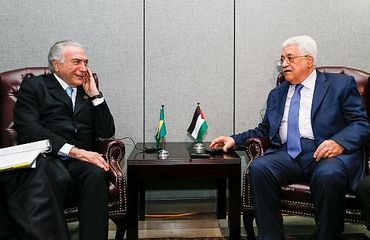
São Paulo – Brazilian president Michel Temer expressed concern over the lack of advances in peace talks between Israelis and Palestinians. “We find the lack of a prospect of peace between Israel and Palestine to be worrisome,” Temer said this Tuesday (20) while addressing the United Nations General Assembly in New York City.
He mentioned that for some time now, Brazil has backed the two-state solution, for “peaceful coexistence within mutually agreed upon, international recognized borders.” “It is everyone’s responsibility to give renewed momentum to the talks,” he stressed.
Later, according to the Brazilian presidency, Temer convened with the president of the Palestinian National Authority (PNA), Mahmoud Abbas, who complimented the Brazilian on his comments.
According to the Brazilian presidency, Abbas gave thanks for the Brazilian government’s donation of the tract of land where the new embassy of Palestine in Brasília was built, and Temer remarked that supporting the creation of a Palestinian state is a tradition in Brazil.
The plot was donated during the administration of former president Luiz Inácio Lula da Silva, and the embassy facilities opened early this year. Abbas himself set the building’s cornerstone on December 31, 2010, during a trip to Brazil to attend the inauguration of former president Dilma Rousseff for her first term in office, on January 1, 2011.
The presidency also reports that Temer made mention of the trip he took to Palestine in 2013, in the capacity of vice president. He invited Abbas to visit Brazil again.
Syria
In his General Assembly address, Temer also said the “[civil] war in Syria continues to give rise to unacceptable suffering.” “The biggest victims are women and children,” he declared. “A political solution can no longer be postponed,” he added, while stressing that “the safety of our citizens depends on the quality of [the international community’s] collective action.”
On Monday (19), the Brazilian foreign minister José Serra met in New York with the Arab League secretary-general Ahmed Aboul-Gheit.
*Translated by Gabriel Pomerancblum

