


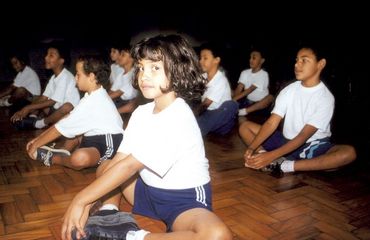
São Paulo – On Serra de Bragança Street, in São Paulo’s Tatuapé neighbourhood, a gate opens up every day to welcome poor children and adolescents from the far east end of São Paulo. Nearly 2,500 little ones arrive to sit remedial classes, learn a trade and enjoy leisure time in a neat sunlit area. In the south side of the city, on Guilherme Valente Street, a similar effort serves some 2,000 kids. Six kilometres away, on Santo Amaro Ave., senior citizens without funds or support go to number 6,487 to get the care their age calls for.
The first one is Lar Sírio Pró-Infância (Syrian Pro-Childhood Home), a child assistance organization, the second one is Cedro do Líbano (Cedar from Lebanon), also for children, and the third one is Mão Branca (White Hand), a home for the elderly. The three institutions were founded by Arab immigrants and are managed by members of the colony. Like those three, other charitable institutions in São Paulo, such as Creche Adélia Curi, for poor kids, attest to the altruism of Arab immigrants and their descendants. “They (the Arabs) have always maintained Lar Sírio with great determination,” says the superintendent Cleide Robertson Paiva.
The histories of these institutions have similarities. They were all set up by Syrian or Lebanese immigrants who were well-received upon arriving in Brazil and decided to give something in return by working to create better opportunities in life to those less fortunate than them. A few meetings between friends here and there and they managed to buy plots wherein they set about to do their social work. The institutions started out with one, two, half a dozen kids or seniors, and now they have become huge. Some serve thousands of people.
The Arab colony is a part of the boards of directors at these places, steering them and also making financial contributions. But now, immigrants, their sons and grandsons are not the only ones who maintain these associations. The institutes live off of donations from people from within and outside the community, agreements with government organizations for certain projects, and some of them have found ways to raise their own funds, such as renting out part of their quarters, as does Lar Sírio. There, says the chairman Celso Emilio Stephano, none of the directors, all of whom are of Syrian or Lebanese ascent, make any systematic financial contribution. “But whenever we have a fundraiser, the directors contribute any way they can, or with as much as they can. The board’s main contribution is their dedication to the association,” he says.
The Lar Sírio board comprises 34 members, mostly founders’ sons. The institution started out as a group of young men from the Syrian city of Homs. They were all small-time merchants who would pool their funds together to help the poor and sick within the colony and those who had stayed back in Homs. Their work gained renown and the group began taking in orphans from Syria. The first ones to arrive were sent to existing institutions, but later the group decided to find their own means to maintain and care for the kids. And thus Lar Sírio was born, in 1923.
At first the organization functioned as an orphanage in a former farm purchased by the immigrants in the Tatuapé neighbourhood. The buildings that harbour the home’s main activities until this day were built using donations from Arab families. After Brazilian adoption laws changed, the orphanage, which is called a shelter, is now a small fraction of Lar Sírio’s work, offering only 20 slots for children and young people sent in by the Children and Juvenile Courts.
Lar Sírio maintains five different social programs, ranging from remedial classes to professional training, including courses in baking and computing; and healthcare, including dental and psychological assistance, among others. The children are from the far east side of São Paulo and live in socially vulnerable conditions. Most live only with their mothers or grandmothers. Lar Sírio has 120 employees and 117 volunteers. The institution’s monthly spending is R$ 400,000 (US$ 201,000 at current exchange rates). This year, Lar Sírio will celebrate its 90th anniversary. “The institution’s work is a case of success in coordinated action between civil society and the private initiative to protect and train children and adolescents in socially risky or vulnerable situations,” says Stephano.
Cedro do Líbano
The work at Cedro do Líbano is also carried out by the descendants of Arab immigrants, only female. It all started with knitting! “These were ladies who would get together to knit blankets for poor children,” says chairwoman Sandra Lutfalla Zarzur regarding the beginnings of the association. The lives of these women of Lebanese ascent would mostly revolve around their husbands and they did not have that many chores to do. So it dawned on them that their employees, the maids, had no one to leave their children with while they worked, so they decided to set up a crèche. As years went by the work grew larger.
Currently, Cedro do Líbano caters to some 2,000 children and adolescents. There are crèches for children aged up to four, and activities such as remedial classes and professional training for the others. The crèche operates with funding from the São Paulo City Hall, even though the facility belongs to Cedro. Outside its quarters, the institution also manages crèches owned by the municipality in the city outskirts. Cedro is partly maintained through donations, but chiefly through agreements with government organizations, says the chairwoman.
Zarzur started working as a volunteer at Cedro about five years ago. A cousin of her father’s, Ivonete Lutfalla Chede, was also a board member. “I take immense pride [on Cedro]. Working here, I learn more than the children do. I learned charity from mymother and joined Cedro after I lost her,” she says. Zarzur claims to take pride in the fact that the Lebanese community performs such highly-regarded work. “I am proud to know that a small group of women created something that has become a benchmark. I love being with the kids,” she says.
Mão Branca
In the Santo Amaro neighbourhood, Mão Branca works on the other end of the social spectrum, old age. It all began in the mid-20th century as well, with a group of ladies originally from Syria and Lebanon. “The original ladies used to meet in an Orthodox Church hall to help people. They would help everyone, no distinctions made. There used to be a senior they supplied with basic foodstuffs and medication, and then he stopped showing up. So they went after him and found him dead, by himself, for some time. Then they took to elderly assistance,” says Mão Branca chairwoman Elizabeth Camasmie Zogbi.
The group of women then bought a 9,000 square kilometre farm plot where they started building a home for unassisted elders. It started out with a small house and a few seniors, and then it grew. People from the Arab colony donated new pavilions and contributions started coming in, from immigrants, descendants and other people. Mão Branca now has 142 beds, two thirds of which are paying, and one third are non-paying. To benefit from the free services, seniors are required to have no children, real estate, or wage. In the facility they receive care, medical, geriatric and nutritional attention, and occupational therapy, among others.
But the ladies who oversee the institution and their employees also make a point of making it a happy place. The elders engage in activities such as gymnastics, costume jewellery and handicraft making, bingo games and others. “Those who can walk and have their intellectual faculties go to the supermarket, the drugstore, and they cook,” says Zogbi. Once a month, birthdays are celebrated and there is a movie and popcorn session. “They get to go to the rental shop and pick a flick,” says the chairwoman.
Aside from revenues from some of the paying seniors, Mão Branca is maintained through donations from people within and outside the Arab colony. In the board itself, there are currently no Syrian-Lebanese members. There are 60 volunteers and 130 employees. In addition to the Santo Amaro headquarters, the association maintains three sociability centres for the third age. One is a partnership with the São Paulo City Hall and the others are exclusively Mão Branca’s.
Creche Adélia Curi
Creche Adélia Curi is another third-sector facility maintained by the Arab community in Brazil. It is kept by Associação Beneficente Sírio-Libanesa, created in 1924 by young colony women who would perform social actions such as sew capes for soldiers during the 1932 Revolution, collect medication to send to the Brazilian Expeditionary Force in Italy, 1945, and help Palestinians, Syrians, Lebanese and the International Red Cross. The crèche was inaugurated in the 1990s by Ivete B. Kanawati Atallah. Presently, the institution caters to approximately 100 children.
In addition to Lar Sírio, Cedro do Líbano, Mão Branca and Creche Adélia Curi, there are other social and charity actions across the city of São Paulo that the Arab colony is involved in. Muslim and Orthodox Christian religious institutions attended by the Arab community also perform social actions, as do hospitals established by the colony, such as Hospital do Coração (HCor) and Hospital Sírio Libanês.
*Translated by Gabriel Pomerancblum
