


Paris – Famous for its collection and for the numbers of visitors it receives each year, since it tops the seven million mark, the Louvre Museum, in Paris, has now a hall reserved for only the Islamic art. Created in 2012, it’s located in one of the internal patios of the building. The collection has more than 14,000 objects, some of them not on display. The majority of the pieces that portray the artistic expression of the Islam, however, are on display for the general public.
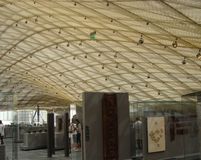
In this section everything is art, starting from the ceiling designed in 2008 by architects Mario Bellini and Rudy Ricciotti. Its wavy design was inspired by the Islamic veils and desert dunes. This ceiling lets in natural light over the objects found from 7 A.D. on in an area that covers Europe, North Africa and South East and Central Asia, regions occupied by the caliphates after the death of the prophet Mohammed in 632 A.D.
In the exhibition it’s possible to follow the evolution of the Islamic art. First, represented by stone sculptures based on Islamic manuscripts or drawings of animals and plants. Later, the drawings gained new surfaces, such as ceramic and glass and begun to display colors in jars, vases and plates. Ivory bas-reliefs, wood carvings and metal sculptures are Islam’s artistic manifestations in exhibition at the Louvre.
The underground levels are dedicated to another famous form of artistic expression of Islam: tapestry. Carpets with more than four meters of length are not rare. In them, the highlights are floral and animal drawings.
One of the highlights of the exhibition is a locked box made during the Umayyad dynasty of Andalusia in the year 966. It’s not known if it was made by an artisan of the dynasty or if it was a gift donated to the Ymayyads. But it is, according to the Louvre, a gift to an important person in the hierarchy. Its manuscript mentions the divine blessing and the year it was made.
When the new wing was inaugurated, the Louvre said that that was an opportunity to bring the museum closer to the Islamic community since its collection is not made only by Western or European art, and that the museum is not only European. The museum is reaching out to the Muslim world. At the end of this year, a branch of the museum should open in Abu Dhabi, capital of the United Arab Emirates.
The construction of this wing had the support of the royal families of Morocco, Kuwait, Oman and Republic of Azerbaijan, a country of Muslim majority that it’s not Arab. The main donation came from Alwaleed Bin Talal foundation, of the Saudi prince and billionaire Alwaleed Bin Talal Al Saud.
*Translated by Sérgio Kakitani
