



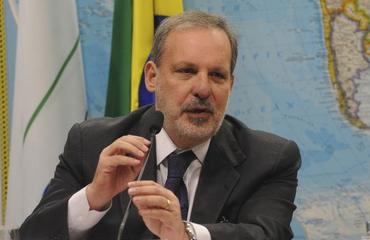
Rio de Janeiro – The trade balance surplus should reach US$ 12 billion this year, according to the forecast made this Tuesday (11th) by the minister of Development, Industry and Foreign Trade, Armando Monteiro. He said to have a very positive view about the current Brazilian economic scenario. According to him, the trade balance surplus closed the first week of August above US$ 5 billion (year-to-date up until the period aforementioned) and estimates indicate more satisfactory numbers.
“Although bold, my estimations from earlier in the year were for a [trade] balance rate between US$ 8 billion and US$ 10 billion. Now it’s already possible to make a projection with a safer margin that our balance rate this year will overcome US$ 10 billion, possibly reaching US$ 12 billion”, said the minister.
He admitted that imports dropped significantly in this period, which, in a way, favored the record of a larger surplus, mas highlighted the fact that the downward trend in imports is being followed by a movement of substitution of these external purchases, which turned more expensive with the dollar appreciation. “This opens up an additional space for the domestic industrial production in a moment in which this [production] goes through a strong retraction. Now, it’s worth mentioning that exports are increasing in volume: the physical part of exports has a significant increase.”
The minister of Development said that if the commodities’ prices (primary products priced in the international market) were in force today, the country would have a larger trade balance surplus. “Surely, it would be approximately US$ 10 billion higher.”
When commenting upon the Chinese yuan devaluation, he said to believe that this is not a problem to Brazil, since the direct relationship of trade with China is focused on commodities. In this sector, Brazil has an “unquestionable” competitiveness, according to him. The minister reminded, however, that Brazil’s foreign exchange market also was significantly realigned – and that the real was the currency with the largest fluctuation, with more than 50% devaluation in the last 12 months. “I think that, if we would consider a basket of currencies, ours is very well situated.”
*Translated by Sérgio Kakitani

