


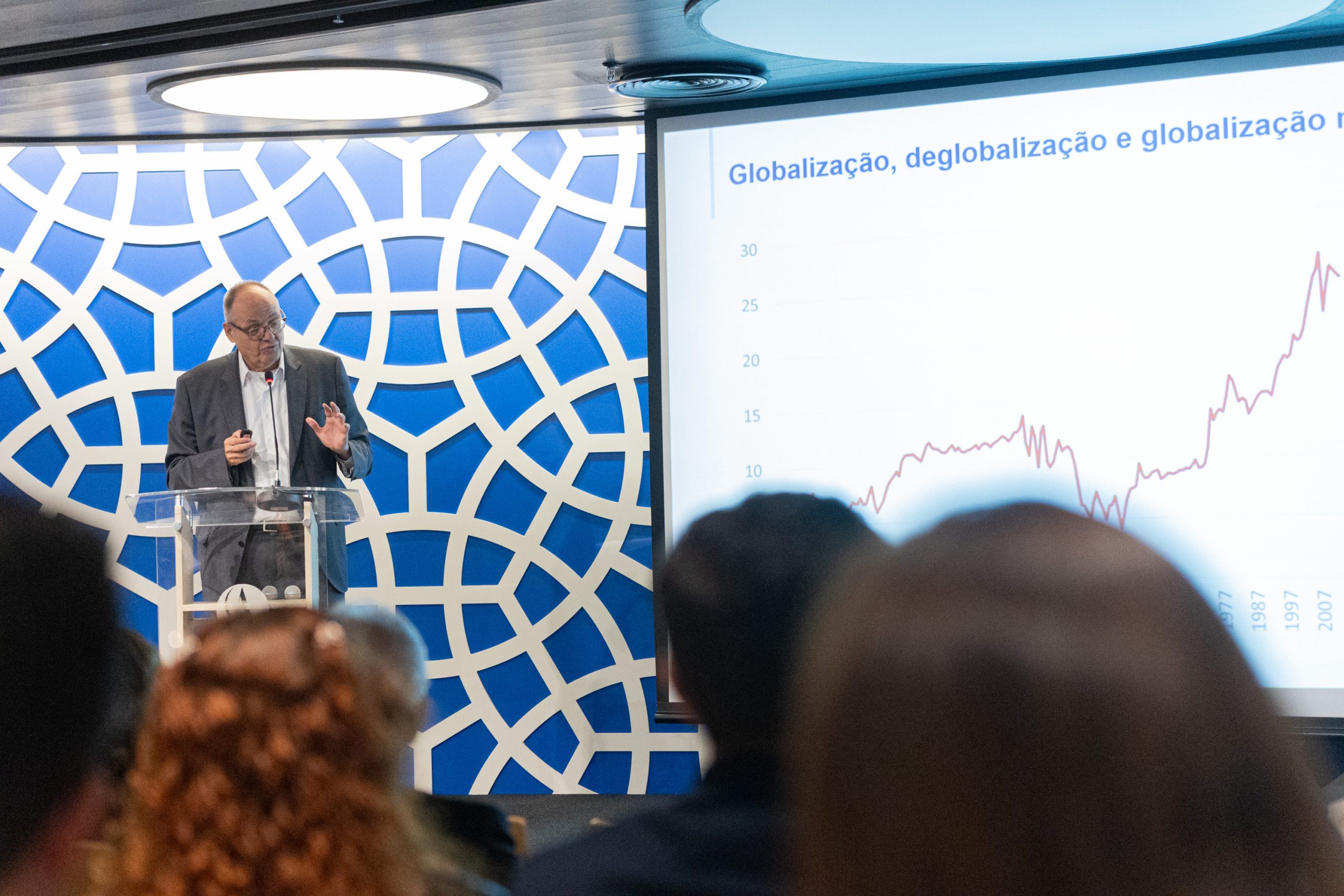
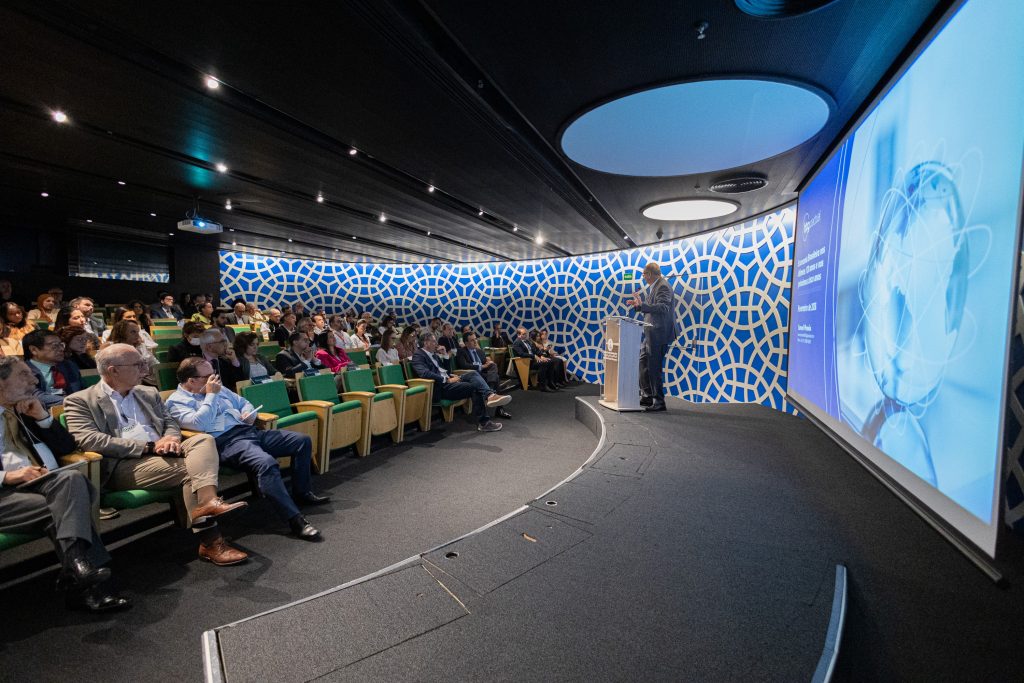
São Paulo – Instability in the United States could have repercussions for the Brazilian and global economies this year, said BTG Pactual macroeconomic researcher Samuel Pessôa during a lecture at the Arab-Brazilian Chamber of Commerce (ABCC). The talk, titled “The Brazilian economy over the past 120 years and the next five years,” opened the ABCC Connects lecture series, focused on perspectives for global economic performance.
Pessôa, who is also a researcher at think tank FGV Ibre, assessed in his presentation the structural challenges to Brazil’s economic growth, this year’s electoral scenario in the country, and how political and economic developments in the U.S. may have positive or negative repercussions on the economy. In 2025, he noted, there was a perception in the U.S. market that President Donald Trump’s political and economic measures created institutional instability while also boosting confidence in the American private sector.
“My assessment is that the depreciation of the U.S. currency is associated with the institutional deterioration taking place in that economy. There’s a president who tries to usurp the prerogatives of other branches of government, attacks the independence of the Central Bank, and is creating problems in domestic defense, and that’s a sign of institutional weakening. So there’s a depreciation of the U.S. dollar, but the stock market is doing very well. People continue to trust the health, sophistication, flexibility, and responsiveness of the American private sector,” he said. According to Pessôa, one effect of the dollar’s decline on other economies is a global disinflationary wave.
Pessôa assessed that this economic performance and these policy measures have also influenced the Brazilian economy, which, in turn, will face challenges to grow from this year onward. Brazil’s gross domestic product expanded by 3.4% in 2024, but the 2025 growth is estimated to have not exceeded 2.2%.
He said the outlook is for a “soft landing” of the economy this year, with GDP growth of around 1.8%, and a decline in the IPCA consumer price index growth to about 4% this year, down from 4.26% in 2025. The key Selic rate, currently at 15%, is expected to begin falling in March and, according to market estimates, reach around 12.5% by the end of the year. According to Pessôa, Brazil’s economy has structural problems that must be addressed for the country to achieve sustainable growth. For this reason, he presented a retrospective of Brazil’s macroeconomic policies over the past 120 years.
Overall, Pessôa outlined problems that affect economic growth and weigh on the country’s capacity to invest and expand. He cited as a challenge the indexation of mandatory minimum spending on health and education. In Brazil, the law requires that health and education expenditures grow in proportion to net revenues. In other words, the higher the country’s revenue, the more funds must be allocated to health and education—equivalent to 15% of net current revenue for health and 18% for education.
Other challenges highlighted by the researcher were the tax structure—which is expected to generate positive impacts over the coming years as a result of the approval of the tax reform—and the high costs of the pension system.
Such burdens associated with government decisions contribute to the increase in public debt and to the country’s high interest rates, which discourage investment. When addressing the major challenges facing the Brazilian economy, he said: “The challenge of our democracy is to create an economic policy framework that delivers growth, reduces inequality, and ensures sustainability. We haven’t managed to achieve that yet.”
Schedule of activities
During ABCC Connects, Marina Sarruf, Director of Marketing and Communication at the ABCC, presented the institution’s calendar of activities for this year in Brazil and abroad. On August 4, the 5th edition of the Brazil–Arab Countries Economic Forum will be held in São Paulo.
The institution will hold roadshows across Brazil to present the Arab market and the Halal do Brasil project to companies interested in doing business both with Arab countries and with non-Arab Islamic nations. Halal products are those made in accordance with Islamic rules and fit for Muslim consumption. The Halal do Brasil project is spearheaded by the ABCC and the Brazilian Trade and Investment Promotion Agency (ApexBrasil) to promote Brazilian halal products.
The roadshows will take place in Rondônia in May, Rio Grande do Sul in July, Espírito Santo in August, Bahia in September, and Ceará in October. The Halal project will host a buyer project with Islamic retailers between April 13 and 17 and is offering the free online course “Exploring the Halal Market – Strategies for Exporters.” The project will also take part in two international trade fairs: MIHAS in Malaysia, from September 23 to 26, and Food Africa in Egypt, from December 7 to 10.
Beyond the Halal project’s activities, the ABCC will take part with its own booth in the food and beverage trade fairs Anuga Select (April 7–9) and APAS (May 18–21) in Brazil, as well as Horeca (April 21–24) in Lebanon. Dedicated to the tourism sector, Horeca will feature both institutional and commercial participation by the ABCC in partnership with the Brazilian Embassy in Beirut. Between January 26 and 30, the institution led companies to Gulfood, the largest food and beverage exhibition in the Middle East, held in Dubai, United Arab Emirates.
Another international initiative is the “Why Brazil?” seminar series. The first edition was held in Bahrain in January, with upcoming editions planned for Kuwait in June, Qatar in October, and Lebanon and Oman in the second half of the year. A multisector trade mission is scheduled for April to Tunisia and Morocco, and another mission, focused on women entrepreneurs through the WAHI Committee, will travel to Jordan.
The ABCC will address presidential elections in one of the next two editions of ABCC Connects. The other edition, scheduled for March, will focus on tourism. Also in March, Mercosur will be highlighted at another traditional event hosted by the institution—the Breakfast with Members, set for March 10, with the theme “The Mercosur–European Union Agreement: Impacts on Arab Countries.” Another edition of the Breakfast with Members will take place in November.
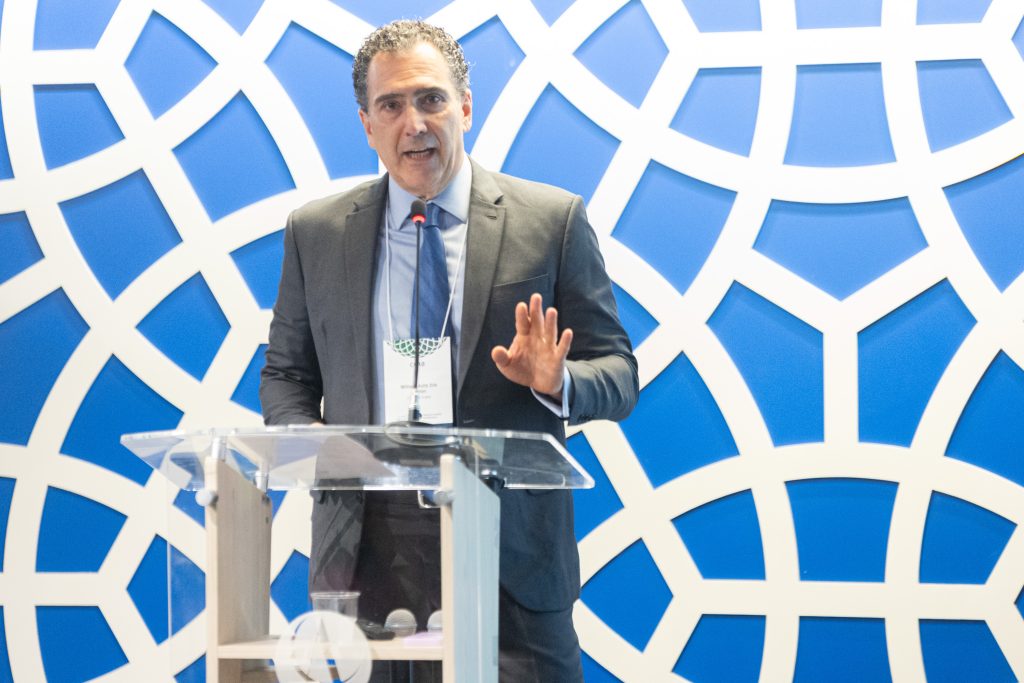
Those attending Monday’s ABCC Connects included ABCC President William Adib Dib Jr., Vice President of Foreign Trade Daniel Hannun, Vice President of Communication and Marketing Silvia Antibas, former president and Chairman of the Superior Administrative Council Marcelo Sallum; board members and former presidents Rubens Hannun and Osmar Chohfi; advisor Nadia Younes; and board members Arthur Jafet, William Atui, Riad Younes, and Sami Roumieh.
“This is the first ABCC Connects of 2026. Through ABCC Connects, the ABCC provides a networking environment for companies and professionals active in the Arab world. In addition to fostering connections and enabling the exchange of information on business and opportunities in the region, ABCC Connects aims to offer in-depth discussions on topics of interest to those seeking to internationalize their operations in Arab countries,” Dib said.
Read more:
Gulfood: Strong market, expansion boost sales
Translated by Guilherme Miranda
