


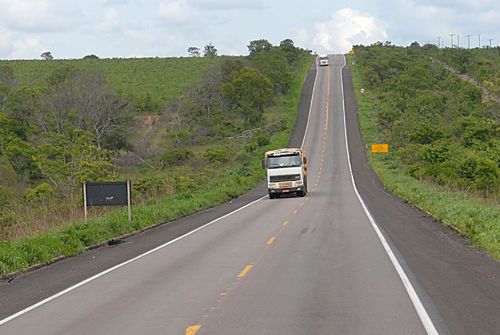
São Paulo – The Brazilian productive sector expects to reduce operating costs and to shorten the transport of goods with the federal highway concessions announced by the government last year. The National Agency for Overland Transport is making progress with the process and should publish the final study for concessions in the second half of June. They should include duplication of parts of seven Brazilian highways in the states of Tocantins, Goiás, Minas Gerais, Mato Grosso do Sul, Mato Grosso, Bahia and Espírito Santo, as well as the Federal District, in a total of 5,748.3 km. The expectation is that bidding by private companies for the concessions should take place later this year.
"Works for duplication of highways should solve the current problems, generating more efficient transport, fewer accidents and lower operating costs," said the president of the National Confederation of Transport (CNT), Clécio Andrade. The roads involved will be the BR 101, 262, 153, 050, 060, 163 and 267, some in more than one stretch. According to Andrade, these routes are of utmost importance for the transport of agricultural and industrial production in Brazil. "Products such as soybeans and maize tend to benefit from lower handling costs," said the CNT president to ANBA.
The state of Mato Grosso do Sul will have 1,423 km of roads tendered to the private initiative, covering parts of BRs 163, 262 and 267.According to the technical adviser to the Federation of Agriculture and Livestock of the State of Mato Grosso do Sul (Famasul), Luke Galvan, the expectation is that, with duplication, products should reach ports faster. The three highways awaiting concession are the main roads of the state to the ports of Santos and Paranaguá, from where the state drains 75% to 80% of agribusiness exports. They are routes to the ports for Mato Grosso state products, reports Galvan.
Minas Gerais will have three highway extensions granted, two on the BR 262 and one on BR-050. According to the economist at the Federation of Industries of the State of Minas Gerais (Fiemg), Paulo Casaca, they are important for the productive sector, mainly because they are routes for the transportation of raw materials, coming from the Midwest, and for the food and drinks industries. Minas Gerais has a strong agribusiness sector, but also includes products from the Midwest for industrial processing. "Minas Gerais is also a crossroads from the Midwest to states that are bathed by the sea," says Casaca.
CNT shows that of the seven roads to be privatised, five are in average condition. Two, the BRs 153 and 050, are in good condition. "As the highway conditions worsen, the operating cost of lorries rises," said Andrade. These costs include fuel, tyre wear and maintenance of the fleet. According to the CNT, on surfaces that are considered good, the operating cost is 18.8% higher than on roads whose surface is considered excellent. On regular surfaces, the cost is 41% higher, on poor surfaces, the cost is 65.6% greater and on awful surfaces, the cost rises 91.5%.
According to Galvan, the preservation of the tarmac on the roads that will be duplicated in Minas Gerais is good. The problem, he said, is the lack of dual carriageways throughout. Lorries lined up along the road, he said, end up affecting passenger car traffic, as they cannot overtake. "This call is age old," says Galvan, regarding the requests for duplication. In Minas, the situation is similar. "These are highways that have long needed to be redone, that are not fully duplicated and this causes many accidents," said Casaca, from Fiemg. The Brazilian Logistics Association (Abralog) also shows accidents as the main problems of the roads that will be privatised and says the benefits will come mainly from improved safety for users.
"Any improvement, especially duplication, enhances safety, average speed and contributes to the productivity of transport," says the marketing vice president of Marketing Abralog, Edson Carillo. He cautions, however, that roads are currently not the best option for goods transport. "For long journeys, especially for the transport of crops, road transportation has not shown itself to be the best alternative," said Carillo.
To Galvan, from Mato Grosso do Sul, a cheaper and more agile option for the transport of agribusiness produce is railways and waterways. But he admits that it is still necessary to invest in highways. "The entire model was turned to roads, so it is now necessary to invest in them, to generate improvement," says the technical advisor at Famasul.
The CNT has identified the need for duplication and the project viability on some stretches to be awarded before the government’s announcement. The organization has a plan for transportation and logistics that points to the need for investment in multimodality in Brazil. "Under the plan it would take over R$ 400 billion (US$ 200 billion) in investment in improvement works and construction of infrastructure in all modes," says the CNT president.
Tolls
One of the concerns of the productive sector, however, is the price of tolls to be applied on these sections. Casaca, from Fiemg, says that highways that have already lived the process indicated that concessions are advantageous. "If tolls are not abusive, it shows itself advantageous," he says. Galvan is of a similar opinion. "Tolls are a concern. Investment is important for the industry, but the cost to users must be considered. This cost cannot increase the cost of the product. The shorter travel time must offset this cost," says technical advisor at Famasul. Abralog also said it expects the cost of tolls to be accessible. "The tendency is for users to perceive the value in the service provided," said Carillo.
The CNT believes that toll costs will be offset by the transport cost, according to Andrade, due to the current road conditions. "But it is worth pointing out that excessively high toll values tend to hinder the development of the industry," says the president of the CNT. Last week, the ANTT announced that there will be an increase in the toll fees initially set by the government for concessions, in an attempt to make the auctions more attractive. The increase was 62% for the BR 153 in Goiás and Tocantins. The ceiling went from R$ 5.84 per hundred kilometres to R $ 9.48 for the same distance.
*Translated by Mark Ament
