



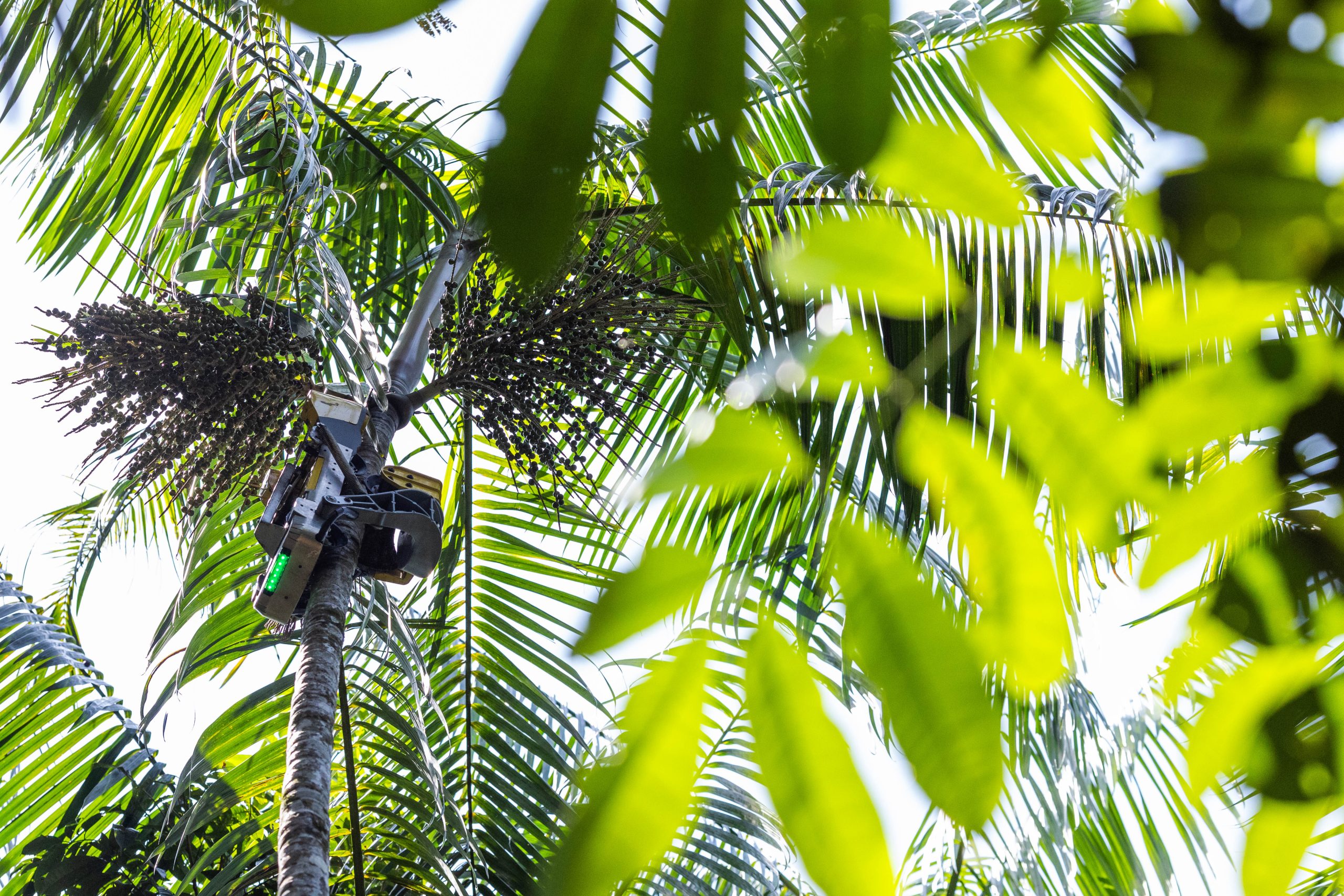
Belém – What was meant to be just an açaí production project in the land of açaí, Pará, turned into much more. As the team behind Açaí Kaa began setting up the business, they encountered several bottlenecks in the supply chain and set out to solve each of them. In the process, they ended up developing not only an açaí production company but also a technology provider for the sector—now aiming to revolutionize how açaí is produced and monetized in Brazil.
The research launched by Açaí Kaa’s entrepreneurs about six years ago led to major results, including the creation of a robot for mechanized açaí harvesting, a new production process that preserves the fruit’s original flavor, harvesting baskets made from recycled materials, and a bio-road for transporting açaí through the forest.
“This work will not benefit only our company—we’re fully aware that it’ll impact the entire açaí production chain,” said Reinaldo Pinto dos Santos, entrepreneur and founder of Açaí Kaa, speaking to a group of journalists in October.
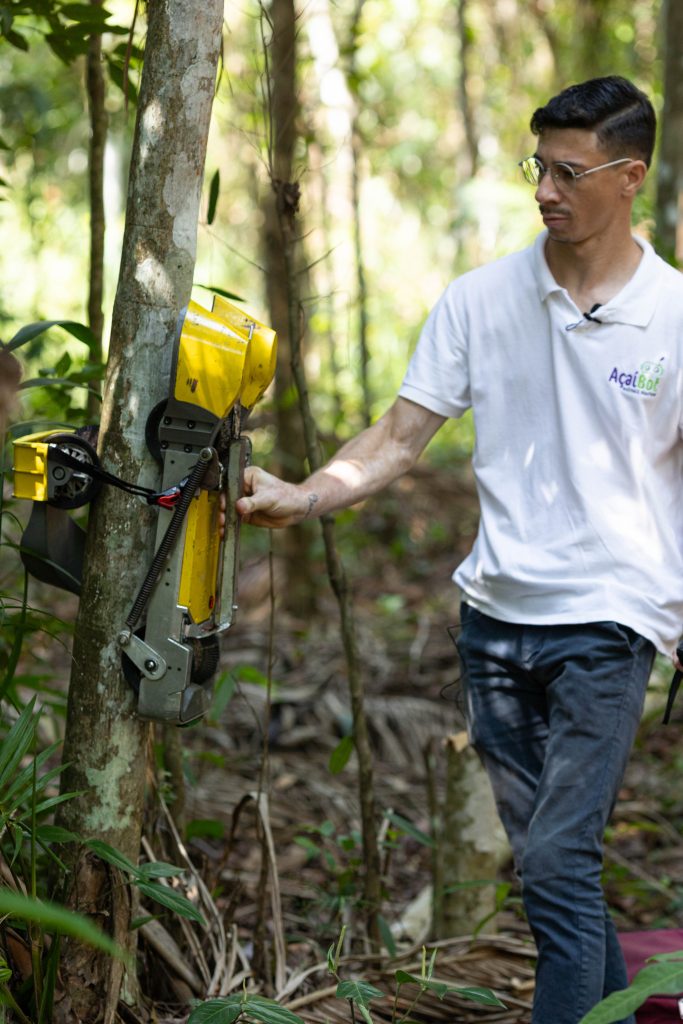
The robot is called Açaí Bot, and like other creations under the umbrella of Kaa Tech, it has been attracting market attention. It all began by noticing how açaí is traditionally harvested. In the conventional method, one must climb the açaí palm—a tall, slender tree—to cut the bunches at the top. “The strenuous nature of the work is simply unacceptable,” says Santos.
The Açaí Bot robot performs this task by climbing the tree and harvesting the bunches. The equipment weighs around eight kilograms, making it easy for riverside families to handle—many of which consist only of grandparents and mothers as the adults. Santos explains that with the current method, a person harvests between 80 and 100 kilograms of açaí per day, but with the robot, they can harvest up to a metric ton.
Given this harvest volume, the company faced the challenge of transportation—how to get the açaí out of the forest—and developed the biopath, a system similar to Lego blocks that can be assembled in the açaí palm area. “It can be carried and set up in the forest, and most importantly, it’s transparent to nature. Animals can move freely across it, as the biopath doesn’t get in the way at all. It has support points and doesn’t bring down a single tree,” says mechanical engineer André Colson Schwob, who works as a technical consultant for the company. “It’ll allow access to a large portion of açaí that has remained beyond our reach until now.”
Under the umbrella of Kaa Tech, a company established to drive technological innovations in the açaí production chain, are also the production of recycled-material boxes for transporting açaí and a biofactory with a monthly capacity of 18,000 improved açaí seedlings. The biofactory uses advanced in vitro cultivation and micropropagation technology, focusing on producing plants of high genetic quality.
Original flavor
At Açaí Kaa, even the main product—the açaí itself—has a story rooted in research. Troubled by the stark difference between the fresh açaí consumed in Pará and the version eaten elsewhere in Brazil and abroad after being frozen for transport, the company set out in search of the ideal product. “The H₂O molecule changes position when frozen. As it shifts, it damages the anthocyanins and harms the flavor—and that damage is irreversible,” explains Santos.

The idea was to produce açaí that could be sold online anywhere in the world with the same flavor as the one sold in Pará. After evaluating existing technologies, Açaí Kaa began searching for new options. “We found a way to process açaí that preserves its qualities 100%,” says Santos, referring to the process in which the açaí returns from powder form to pulp. “With this technology in hand—scalable and economically viable—you can process large quantities of the fruit,” Santos explains.
The technological solutions developed from the creation of Açaí Kaa will be used by the company itself but are also available on the market. “The idea is to benefit the entire value chain,” explains Açaí Kaa’s executive director, Marcelo Feliciano. In October, the robot was being sold for BRL 19,569.20 [USD 3,653.84] on the Kaa Tech website, with delivery scheduled within 60 days. The biopath is also already available for purchase, according to Feliciano.
Reinaldo Pinto dos Santos says that this process, in addition to involving a highly qualified team, included several partnerships—with researchers, universities, Brazilian and international companies, the Pará State Department of Agricultural and Fisheries Development (Sedap), Pará state agriculture federation FAEPA, and Brazil’s agribusiness lobby, CNA. The state of Pará is located in the Amazon rainforest region.
Read the other features in the series:
*The journalist traveled at the invitation of CNA
Translated by Guilherme Miranda
