


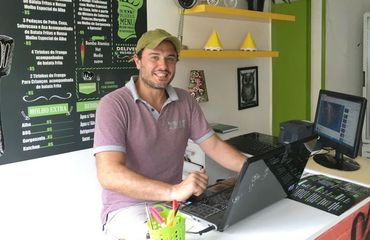
São Paulo – Adam Hamwia, a 36-year-old Syrian, arrived in Brazil in late 2013 as a refugee. He tried to get a good job, but failed, and so he decided to follow on the footsteps of early 20th century Arab immigrants to Brazil: entrepreneurship. Hamwia opened the restaurant Adoomy in the Vila Madalena district. The stars of the menu are wraps, the “best French fries around” and fried chicken. Prices start at BRL 5.50, and light and cholesterol-free options are available.
“Cooking used to be a hobby for me, but I decided to make money out of it after going through so much hardship in Brazil,” he told ANBA during a conversation at his restaurant and home on Wednesday (17). Embarking on this challenge was not plan A for this businessman, who completed a degree in Business Administration back in Syria.
After leaving Syria, he lived in Cairo, Egypt for a few months, but was unable to secure a foothold, so he relocated to Brazil to get a fresh start. “It was the only place I could live legally in. There were other options, like the US and Germany, but I wouldn’t have had legal status there,” he said. “The only thing we know about when we decide to go to Brazil is that it’s a country where there’s samba and football, and that your people are passionate about football from a very early age,” he said.
Upon arriving in São Paulo, he recalls that he had many problems. He didn’t speak Portuguese and Brazilians didn’t speak Arabic or English. He struggled with paperwork requirements for registering as a refugee. Since he had money, he had to pay taxes on his income. He was taken aback by the lack of information about the Syrian conflict, and complained that many of the refugees who come to Brazil are skilled people and potential investors.
“We can’t get good jobs. All we get is bad proposals that aren’t on par with our abilities and training. I didn’t get support from the local Arab community. I couldn’t rent a place to live in because rental contracts require a guarantor. How can I get a guarantor when I just arrived from Syria,” Hamwia inquires.
In late 2014, he decided he’d have his own eatery, “I took some of my money, offered the property owner a down payment, renovated the place and opened the restaurant. But things haven’t been easy. Employees I hired stole from me, and I have problems with my neighbors (a snack bar). I get the feeling I am being targeted by prejudice because I’m a refugee.”
The venture cost roughly USD 60,000. There are times when the house is packed, he says. “It gets crowded when we have happy hours or birthday parties, and we are having those often. But on days like today, we don’t get that many customers. I only had people on two tables during lunch,” he said.
Hamwia lives in the upper floor. He converted the house into a small hostel and earns some extra cash by renting out to tourists. A Frenchman, an Australian and an American are currently living in Hamwia.
He claims that despite all the challenges, he doesn’t consider leaving Vila Madalena and says returning to Syria is unlikely. “I have been to Porto Alegre (in the state of Rio Grande do Sul), Curitiba (in Paraná), Florianópolis (Santa Catarina), Ribeirão Preto, Campinas, Ubatuba, Ilhabela (São Paulo) and Paraty (no Rio de Janeiro), among other cities. Those are beautiful places, but they aren’t like São Paulo, because here you create your own opportunity and you can thrive. São Paulo is very diverse, with lots of people, and my neighborhood, Vila Madalena, is particularly diverse. There’s a lot of energy in São Paulo, it’s unlike anyplace else,” he says.
Adoomy restaurant
Rua Rodésia, 140, Vila Madalena, São Paulo – SP – Upper Floor
Additional information: https://www.facebook.com/adoomyrestaurante/info?tab=overview
*Translated by Gabriel Pomerancblum
