



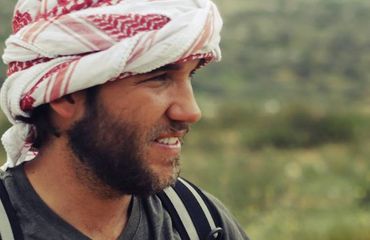
São Paulo – A civil justice lawyer who’s passionate for Human Rights, Edgard Raoul, from São Paulo, decided to experience first-hand the life of a refugee. In a trip that started as he left São Paulo for New York, he visited Turkey, Greece, Germany, Palestine, Jordan, Syria and Lebanon. What he experienced in these countries changed his conceptions on Arab and Muslims.
Raoul’s saga started on November 2015, when he moved to New York to do volunteer work in major Human Right international organizations. “I wanted to understand how these organizations operated. I went to New York because [their] headquarters were there,” he says.
Realizing that operations in New York were more theoretical than hands-on, Raoul decided to go to Turkey, a country that was and is receiving thousands of refugees from Syria. “There, I got to live with refugees and I understood what was happening in the Middle East. One of the refugees that I lived with had floated in the sea on the body of his 11-year-old son. When you hear the story of what [such a] a person went through, you feel her pain,” he says.
“My focus was set on understanding the reality of these people. I was someone that they could tell what they were going through to,” says Raoul on the days he spent in Turkey. From there, he travelled to the island of Lesbos, Greece, the main gateway for Syrians trying to reach the European Union.
“In Lesbos, I learned more about the refugees’ cultural traditions, to help in their interactions with the volunteers”, says the lawyer. He says that despite the will to help by the volunteers, there were a lot of disagreements with the Arabs due to cultural differences regarding the behavior towards women, for instance, who did not want to be touched because of religious matters.
To Raoul, one of the most touching experiences for him in the Greek island was when he took in his arms a little girl from the arms of her father that had just landed from a boat. Cold and unconscious, the child seemed dead. “I warmed her and she woke up. After that, I handed her to the Red Cross, but for a moment there, I carried a child that I believed was dead,” he says. “That was when the crisis that I would look at, but couldn’t really see, touched me,” he adds.
Then the lawyer changed his plans once again. Instead of helping the refugees, he decided to live as one. “From Lesbos to Germany I travelled in disguise to understand the crisis, not as a volunteer but as a refugee.”
The trip from Greece to the German city of Frankfurt took 26 days. “The refugees took me in as a son,” tells Raoul. He says that like any other Brazilian, he grew up hearing all sorts of stereotypes on Arabs and Muslims, such as those that link them to dangerous people and terrorists. To him, the trip completely changed this idea. “I became an advocate of Muslims without being one,” he points out.
Using another identity so as to not be identified as Brazilian, Raoul ended up being arrested in Serbia after local authorities found his passport and thought he was a Syrian travelling with a fake Brazilian document. “What made them release me was a picture I had in my cell phone with [the Serbian tennis player Novak] Djokovic. He’s an idol over there and they probably thought I was someone important,” he says.
Raoul also points out the high cost of the trip for those escaping war. According to him, the Syrians’ journey to Europe costs from five to seven thousand euros per person. “People who have no money stay in Jordan and Lebanon,” he says.
After the long trip to Germany, Raoul took a one-month break from his saga as a refugee. He spent that time in Holland studying Middle East politics, religion, culture and society with the help of a journalist from Bahrain.
Better informed on the region, Raoul went to Palestine. “There, I lived as a Palestinian. I worked in an organic farm as a Bedouin. In the protests, when the Israeli army would come, I stood there as a Palestinian. I was shot with a rubber bullet and would hide behind the trees when they shot live ammunition,” he says.
From Palestine, the lawyer went to Jordan, where he was mistaken by the country’s secret service as a member of the Islamic State. Without being able to stay in hotels, which turned him down, he got lodging and food in family homes. Still being followed by the country’s secret service, Raoul had to seek help in the Brazilian embassy, which supported him and gave him an official document to guarantee his safety.
Even under surveillance, Raoul was able to visit the United Nations refugee camps for Palestinians and also refugee camps that aren’t registered at the international agencies. “There are more than one million unregistered refugees in Jordan and more than one million in Lebanon,” points out the lawyer. “Jordan and Lebanon are doing the impossible in order to welcome the refugees,” he says.
And Lebanon was where he ended his saga throughout the Arab world. There, Raoul lived in unregistered refugee camps and held a local NGO. Before he left, he was able to cross the border with Syria and saw a little of the war that is devastating the country since 2011.
Back in Brazil, he says he left his heart back in the Middle East. Here, he hopes to help change the fact that Middle East people are seen in a negative light. I was welcomed in a wonderful way in the Middle East. Why are we not able to do the same? We have made up a wrong image that needs to be deconstructed. The Islamic State cannot represent Muslims,” he adds.
*Translated by Sérgio Kakitani

