



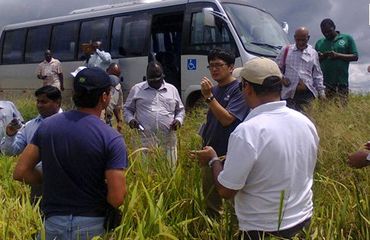
São Paulo – African countries representatives, including a Mauritanian one, were in Brazil earlier this month to learn about the cropping and industrialization of rice in the country. The group included by technicians, entrepreneurs and government members of the nations comprising the project Africa Rice, were in the states of of Tocantins and Goiás. “All of them showed a lot of interest, they were very excited”, the researcher and coordinator of the Brazilian Agricultural Research Corporation’s (Embrapa, in the Portuguese acronym) Arroz e Feijão in Tocantins, Daniel Fragoso told ANBA’s Newsroom.
The Mauritanian Sidy Yeslemi Vall, from the company MSA, is part of the group. Vall works with as a representative in rice industry and equipment for this sector in East and Central Africa. He also works with sales of repair parts for production machinery, such as harvesters, tractor, and others. According to information supplied by the Mauritanian by email to ANBA, he came to Brazil to know the country and see what kind of business he can do.
The remaining countries represented were Burundi, Benin, Burkina Faso, Cameroon, Ivory Coast, Ethiopia, Ghana, Mali, Nigeria, Rwanda, Senegal, Sierra Leone, Tanzania and Uganda. The project Africa Rice, the group they belong to and which ran the trip, is banked by the Japanese government in the area and to boost rice production in the African countries.
According to Fragoso, Embrapa has partnerships with African countries for the cooperation and transference of technology in the rice segment and this visit is part of it. The idea is to help African countries to fight off famine. According to Embrapa’s researcher, the scenario of rice production in Tocantins is very different from the African, in terms of technology, variety and quality. Brazil is, according to him, much more advanced.
“They had the opportunity to see, in loco, how [the rice production in Brazil] happens. It has broadened their point of view to a more advanced reality,” claims Fragoso. The rice cropped in Tocantins, as well as in the Brazilian states of Rio Grande do Sul and Santa Catarina, is flood-irrigated. In Goiânia they have actually seen some highland crops, without irrigation, closer to the method used in African countries. “There is a a high climate risk because it relies only on the rain,” says Fragoso about this last option, rarely used in Brazil nowadays.
The Africans had the opportunity to know cropping and processing areas, both small and large facilities. They had lectures by Embrapa’s professionals, by the Tocantins’ secretary of Agriculture, they visited processing plants, farms, laboratories and got in touch with rice-production machinery manufacturers.
*Translated by Rodrigo Mendonça
